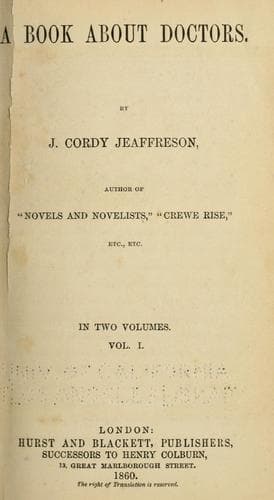
Medicine -- Anecdotes; Physicians -- Great Britain
Not less instructive would it be for many who now know of them only
through begging circulars and charity dinners, to inspect the
well-ventilated, cleanly--and it may be added, _cheerful_--dwellings
of the impoverished sick of London. The principal hospitals of the
capital, those, namely, to which medical schools are attached, are
eleven in number--St. George's, the London (at Mile End), University
College, King's, St. Mary's, Westminster, Middlesex, and
Charing-cross, are for the most part dependent on voluntary
contributions for support, the Westminster Hospital (instituted 1719)
being the first hospital established in this kingdom on the voluntary
system. The three other hospitals of the eleven have large endowments,
Bartholomew's and Guy's being amongst the wealthiest benevolent
foundations of the country.
Like Bethlehem, St. Thomas's Hospital was originally a religious
house. At the dissolution of the monasteries it was purchased by the
citizens of London, and, in the year 1552, was opened as an hospital
for the sick. At the commencement of the last century it was rebuilt
by public subscription, three wards being erected at the cost of
Thomas Frederick, and three by Guy, the founder of Guy's Hospital.
The first place of precedency amongst the London Hospitals is
contended for by St. Bartholomew's and Guy's. They are both alike
important by their wealth, the number of patients entertained within
their walls, and the celebrity of the surgeons and physicians with
whom their schools have enriched the medical profession; but the
former, in respect of antiquity, has superior claims to respect.
Readers require no introduction to the founder of Bartholomew's, for
only lately Dr. Doran, in his "Court Fools," gave a sketch of
Rahere--the minstrel and jester, who spent his prime in the follies
and vices of courts, and his riper years in the sacred offices of the
religious vocation. He began life a buffoon, and ended it a
prior--presiding over the establishment to the creation of which he
devoted the wealth earned by his abused wit. The monk chronicler says
of him: "When he attained the flower of youth he began to haunt the
households of noblemen and the palaces of princes; where, under every
elbow of them, he spread their cushions with apeings and flatterings,
delectably anointing their eyes--by this manner to draw to him their
friendships. And yet he was not content with this, but often haunted
the king's palace; and, among the press of that tumultuous court,
enforced himself with jollity and carnal suavity, by the which he
might draw to him the hearts of many one." But the gay adventurer
found that the ways of mirth were far from those of true gladness;
and, forsaking quips, and jeers, and wanton ditties for deeds of
mercy, and prayer, and songs of praise, he long was an ensample unto
men of holy living; and "after the years of his prelacy (twenty-two
years and six months), the 20th day of September (A. D. 1143), the
Public-domain text, read in full here on John Shaqi.
Reviews
Reviews
No reviews yet
Be the first to share your thoughts on this work.
Elsewhere in the archive
Join the Discussion
Join the discussion
Sign in to leave a comment or review.
Sign InorCreate an account