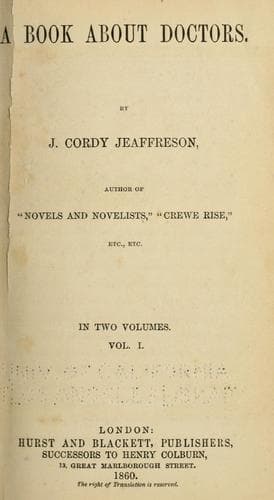
Medicine -- Anecdotes; Physicians -- Great Britain
The fore-arms, now in the custody of the College of Surgeons, were for
a time separated. One of them was retained by Mr. Cullum, and the
other, becoming the property of some mute inglorious Barnum, was taken
about to all the fairs and wakes of the county, and exhibited as a
raree-show at a penny a peep. The vagrant member, however, came back
after a while to Mr. Cullum, and he presented both of the mutilated
pertions to their present possessors.
CHAPTER XXVII.
THE COUNTRY MEDICAL MAN.
The country doctor, such as we know him--a well-read and observant
man, skilful in his art, with a liberal love of science, and in every
respect a gentleman--is so recent a creation, that he may almost be
spoken of as a production of the present century. There still linger
in the provinces veteran representatives of the ignorance which, in
the middle of the last century, was the prevailing characteristic of
the rural apothecary. Even as late as 1816, the law required no
medical education in a practitioner of the healing art in country
districts, beyond an apprenticeship to an empiric, who frequently had
not information of any kind, beyond the rudest elements of a
druggist's learning, to impart to his pupils. Men who commenced
business under this system are still to be found in every English
county, though in most cases they endeavour to conceal their lack of
scientific culture under German or Scotch diplomas--bought for a few
pounds.
Scattered over these pages are many anecdotes of provincial doctors in
the sixteenth and seventeenth centuries, from which a truthful but
not complimentary picture of their order may be obtained. Indeed, they
were for the most part vulgar drunken knaves, with just learning
enough to impose on the foolish crowds who resorted to them. The most
brilliant of the fraternity in Henry the Eighth's reign was Andrew
Borde, a Winchester practitioner. This gentleman was author and
buffoon, as well as physician. He travelled about the country from
market to fair, and from fair to market, making comic orations to the
crowds who purchased his nostrums, singing songs, and enlivening the
proceedings when they were becoming dull with grimaces of
inexpressible drollery. It was said of Sir John Hill,
"For physic and farces
His equal there scarce is;
His farces are physic,
His physic a farce is."
Borde's physic doubtless was a farce; but if his wit resembled physic,
it did so, not (like Hill's) by making men sick, but by rousing their
spirits and bracing their nerves with good hearty laughter. Everywhere
he was known as "Merry Andrew," and his followers, when they mounted
the bank, were proud to receive the same title.
Public-domain text, read in full here on John Shaqi.
Reviews
Reviews
No reviews yet
Be the first to share your thoughts on this work.
Elsewhere in the archive
Join the Discussion
Join the discussion
Sign in to leave a comment or review.
Sign InorCreate an account