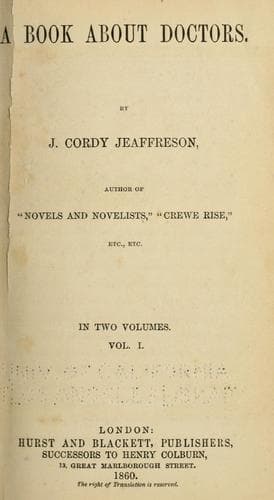
Medicine -- Anecdotes; Physicians -- Great Britain
May a word not be here said on the toping country doctor? Shame on
these times! ten years hence one will not be able to find a bibulous
apothecary, though search be made throughout the land from Dan to
Beersheba! Sailors, amongst the many superstitions to which they cling
with tenacity, retain a decided preference for an inebrious to a sober
surgeon. Not many years since, in a fishing village on the eastern
coast, there flourished a doctor in great repute amongst the poor; and
his influence over his humble patients literally depended on the fact
that he was sure, once in the four-and-twenty hours, to be handsomely
intoxicated. Charles Dickens has told the public how, when he bought
the raven immortalised in "Barnaby Rudge," the vendor of that
sagacious bird, after enumerating his various accomplishments and
excellences, concluded, "But, sir, if you want him to come out very
strong, you must show him a drunk man." The simple villagers of
Flintbeach had a firm faith in the strengthening effects of looking at
a tipsy doctor. They always postponed their visits to Dr. Mutchkin
till evening, because then they had the benefit of the learned man in
his highest intellectual condition. "Dorn't goo to he i' the mornin',
er can't doctor noways to speak on tills er's had a glass," was the
advice invariably given to a stranger not aware of the doctor's little
peculiarities.
Mutchkin was unquestionably a shrewd fellow, although he did his best
to darken the light with which nature had endowned him. One day,
accompanied by his apprentice, he visited a small tenant farmer who
had been thrown on his bed with a smart attack of bilious fever. After
looking at his patient's tongue and feeling his pulse, he said
somewhat sharply:--
"Ah! 'tis no use doing what's right for you, if you will be so
imprudent."
"Goodness, doctor, what do you mean?" responded the sick man; "I have
done nothing imprudent."
"What!--nothing imprudent? Why, bless me, man, you have had green peas
for dinner."
"So I have, sir. But how did you find that out?"
"In your pulse--in your pulse. It was very foolish. Mind, you mayn't
commit such an indiscretion again. It might cost you your life."
The patient, of course, was impressed with Mutchkin's acuteness, and
so was the apprentice. When the lad and his master had retired, the
former asked:--
"How did you know he had taken peas for dinner, sir? Of course it
wasn't his pulse that told you."
"Why, boy," the instructor replied, "I saw the pea-shells that had
been thrown into the yard, and I drew my inference."
The hint was not thrown away on the youngster. A few days afterwards,
being sent to call on the same case, he approached the sick man, and,
looking very observant, felt the pulse.
"Ah!--um--by Jove!" exclaimed the lad, mimicking his master's manner,
"this is very imprudent. It may cost you your life. Why, man, you've
eaten a horse for your dinner."
Public-domain text, read in full here on John Shaqi.
Reviews
Reviews
No reviews yet
Be the first to share your thoughts on this work.
Elsewhere in the archive
Join the Discussion
Join the discussion
Sign in to leave a comment or review.
Sign InorCreate an account