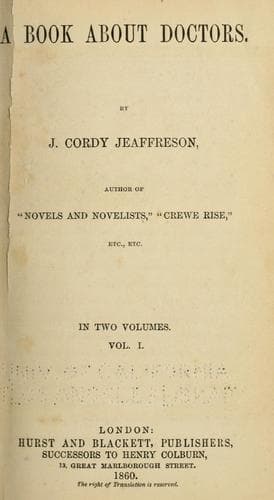
Medicine -- Anecdotes; Physicians -- Great Britain
He was fond of declaring that he wished for an Act of Parliament
entitling nurses to the sole and entire medical care of women. A lady
who consulted him about a nervous singing in the head was advised to
"curl her hair with a ballad." His scorn of women was not lessened by
the advances of certain disorderly ladies of condition, who displayed
for him that morbid passion which medical practitioners have often to
resist in the treatment of hysterical patients. Yet he tried his luck
once again at the table of love. "There's no fool so great as an old
fool." In the summer of 1709, Radcliffe, then in his sixtieth year,
started a new equipage; and having arrayed himself in the newest mode
of foppery, threw all the town into fits of laughter by paying his
addresses, with the greatest possible publicity, to a lady who
possessed every requisite charm--(youth, beauty, wealth)--except a
tenderness for her aged suitor. Again was there an unlucky termination
to the doctor's love, which Steele, in No. 44 of _The Tatler_,
ridiculed in the following manner:--
"This day, passing through Covent Garden, I was stopped in the Piazza
by Pacolet, to observe what he called _The Triumph of Love and Youth_.
I turned to the object he pointed at, and there I saw a gay gilt
chariot, drawn by fresh prancing horses, the coachman with a new
cockade, and the lacqueys with insolence and plenty in their
countenances. I asked immediately, 'What young heir, or lover, owned
that glittering equipage!' But my companion interrupted, 'Do not you
see there the mourning Æsculapius?' 'The mourning!' said I. 'Yes,
Isaac,' said Pacolet, 'he is in deep mourning, and is the languishing,
hopeless lover of the divine Hebe, the emblem of Youth and Beauty.
That excellent and learned sage you behold in that furniture is the
strongest instance imaginable that love is the most powerful of all
things.
"'You are not so ignorant as to be a stranger to the character of
Æsculapius, as the patron and most successful of all who profess the
Art of Medicine. But as most of his operations are owing to a natural
sagacity or impulse, he has very little troubled himself with the
Doctrine of Drugs, but has always given Nature more room to help
herself than any of her learned assistants; and consequently has done
greater wonders than in the power of Art to perform; for which reason
he is half deified by the people, and has ever been courted by all the
world, just as if he were a seventh son.
Public-domain text, read in full here on John Shaqi.
Reviews
Reviews
No reviews yet
Be the first to share your thoughts on this work.
Elsewhere in the archive
Join the Discussion
Join the discussion
Sign in to leave a comment or review.
Sign InorCreate an account