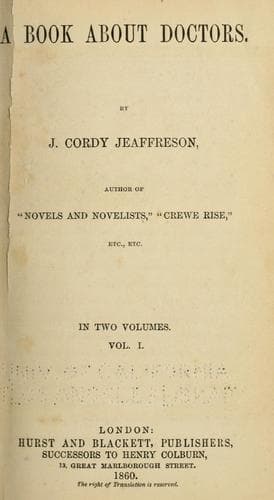
Medicine -- Anecdotes; Physicians -- Great Britain
"'It happened that the charming Hebe was reduc'd, by a long and
violent fever, to the most extreme danger of Death; and when all skill
failed, they sent for Æsculapius. The renowned artist was touched with
the deepest compassion, to see the faded charms and faint bloom of
Hebe; and had a generous concern, too, in beholding a struggle, not
between Life, but rather between Youth, and Death. All his skill and
his passion tended to the recovery of Hebe, beautiful even in
sickness; but, alas! the unhappy physician knew not that in all his
care he was only sharpening darts for his own destruction. In a word,
his fortune was the same with that of the statuary who fell in love
with an image of his own making; and the unfortunate Æsculapius is
become the patient of her whom he lately recovered. Long before this,
Æsculapius was far gone in the unnecessary and superfluous amusements
of old age, in the increase of unwieldy stores, and the provision in
the midst of an incapacity of enjoyment, of what he had for a supply
of more wants than he had calls for in Youth itself. But these low
considerations are now no more; and Love has taken place of Avarice,
or rather is become an Avarice of another kind, which still urges him
to pursue what he does not want. But behold the metamorphosis: the
anxious mean cares of an usurer are turned into the languishments and
complaints of a lover. "Behold," says the aged Æsculapius, "I submit;
I own, great Love, thy empire. Pity, Hebe, the fop you have made. What
have I to do with gilding but on Pills? Yet, O Fate! for thee I sit
amidst a crowd of painted deities on my chariot, buttoned in gold,
clasp'd in gold, without having any value for that beloved metal, but
as it adorns the person and laces the hat of the dying lover. I ask
not to live, O Hebe! Give me but gentle death. Euthanasia, Euthanasia!
that is all I implore."' When Æsculapius had finished his complaint,
Pacolet went on in deep morals on the uncertainty of riches, with
this remarkable explanation--'O wealth! how impatient art thou! And
how little dost thou supply us with real happiness, when the usurer
himself cannot forget thee, for the love of what is foreign to his
felicity, as thou art!'"
Public-domain text, read in full here on John Shaqi.
Reviews
Reviews
No reviews yet
Be the first to share your thoughts on this work.
Elsewhere in the archive
Join the Discussion
Join the discussion
Sign in to leave a comment or review.
Sign InorCreate an account