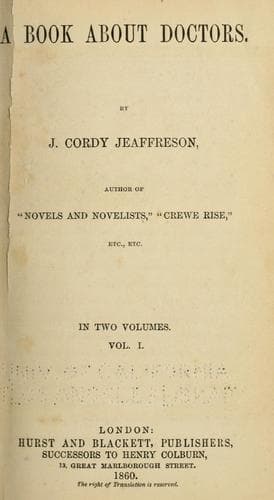
Medicine -- Anecdotes; Physicians -- Great Britain
But, though medical practitioners have dealt in sayings like these, to
do them bare justice, it must be admitted that their preaching has
generally been contradicted by the practice. When medicine remained
very much in the hands of the ladies, the composition of remedies, and
the making of dinners, went on in the same apartment. Indeed hunger
and thirst were but two out of a list of diseases that were ministered
to by the attendants round a kitchen table. The same book held the
receipts for dishes and the recipes for electuaries. In many an old
hall of England the manual still remains from which three centuries
ago the lady of the house learned to dress a boar's head or cure a
cold. Most physicians would now disdain to give dietetic instruction
to a patient beyond the most general directions; but there are cases
where, even in these days, they stoop to do so, with advantage to
themselves and their patients.
"I have ordered twelve dinners this morning," a cheery little doctor
said to the writer of these pages, on the white cliffs of a well-known
sea-side town.
"Indeed--I did not know that was your business."
"But it is. A host of rich old invalids come down here to be
medicinally treated. They can't be happy without good living, and yet
are so ignorant of the science and art of eating, that they don't know
how to distinguish between a luxurious and pernicious diet, and a
luxurious and wholesome one. They flock to the 'Duke's Hotel,' and I
always tell the landlord what they are to have. Each dinner costs
three or four guineas. They'd grudge them, and their consciences would
be uneasy at spending so much money, if they ordered their dinners
themselves. But when they regard the fare as medicine recommended by
the doctor, there is no drawback to their enjoyment of it. Their
confidence in me is unbounded."
The bottle and the board were once the doctor's two favourite
companions. More than one eminent physician died in testifying his
affection for them. In the days of tippling they were the most
persevering of tavern-haunters. No wonder that some of them were as
fat as Daniel Lambert, and that even more died sudden deaths from
apoplexy. The obesity of Dr. Stafford was celebrated in an epitaph:--
"Take heed, O good traveller, and do not tread hard,
For here lies Dr. Stafford in all this churchyard."
Dr. Beddoes was so stout that the Clifton ladies used to call him
their "walking feather-bed."
Dr. Flemyng weighed twenty stone and eleven pounds, till he reduced
his weight by abstinence from the delicacies of the table, and by
taking a quarter of an ounce of common Castile soap every night.
Dr. Cheyne's weight was thirty-two stone, till he cured himself by
persevering in a temperate diet. Laughing at two unwieldly noblemen
whose corpulence was the favourite jest of all the wits in the court,
Louis XV. said to one of them, "I suppose you take little or no
exercise."
Public-domain text, read in full here on John Shaqi.
Reviews
Reviews
No reviews yet
Be the first to share your thoughts on this work.
Elsewhere in the archive
Join the Discussion
Join the discussion
Sign in to leave a comment or review.
Sign InorCreate an account