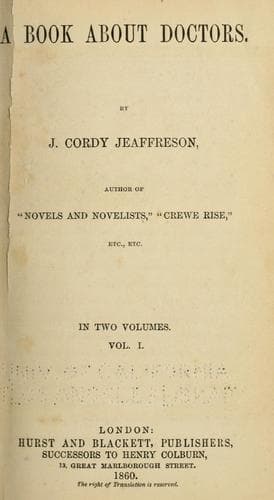
Medicine -- Anecdotes; Physicians -- Great Britain
Gibbons--the "Nurse Gibbons" of our old friend Radcliffe--was a deep
drinker, disgusting, by the grossness of his debaucheries, the polite
and epicurean Garth. But Gibbons did something for English
dinner-tables worth remembering. He brought into domestic use the
mahogany with which we have so many pleasant associations. His
brother, a West Indian Captain, brought over some of the wood as
ballast, thinking it might possibly turn to use. At first the
carpenters, in a truly conservative spirit, refused to have anything
to do with the "new wood," saying it was too hard for their tools. Dr.
Gibbons, however, had first a candle-box and then a bureau made for
Mrs. Gibbons out of the condemned material. The bureau so pleased his
friends, amongst whom was the Duchess of Buckingham, that her Grace
ordered a similar piece of furniture, and introduced the wood into
high life, where it quickly became the fashion.
Of Radcliffe's drunkenness mention is made elsewhere. As an eater, he
was a _gourmand_, not a _gourmet_. When Prince Eugene of Savoy came
over to England on a diplomatic mission, his nephew, the Chevalier de
Soissons, fell into the fashion of the town, roaming it at night in
search of frays--a roaring, swaggering mohock. The sprightly
Chevalier took it into his head that it would be a pleasant thing to
thrash a watchman; so he squared up to one, and threatened to kill
him. Instead of succumbing, the watchman returned his assailant's
blows, and gave him an awful thrashing. The next day, what with the
mauling he had undergone, and what with _delirium tremens_, the merry
roisterer was declared by his physician, Sieur Swartenburgh, to be in
a dying state. Radcliffe was called in, and acting on his almost
invariable rule, told Prince Eugene that the young man must die,
_because_ Swartenburgh had maltreated him. The prophecy was true, if
the criticism was not. The Chevalier died, and was buried amongst the
Ormond family in Westminster Abbey--it being given out to the public
that he had died of small-pox.
Prince Eugene conceived a strong liking for Radcliffe, and dined with
him at the Doctor's residence. The dinner Radcliffe put before his
guest is expressive of the coarseness both of the times and the man.
On the table the only viands were barons of beef, jiggets of mutton,
legs of pork, and such other ponderous masses of butcher's stuff,
which no one can look at without discomfort, when the first edge has
been taken off the appetite. Prince Eugene expressed himself delighted
with "the food and liquors!"
Public-domain text, read in full here on John Shaqi.
Reviews
Reviews
No reviews yet
Be the first to share your thoughts on this work.
Elsewhere in the archive
Join the Discussion
Join the discussion
Sign in to leave a comment or review.
Sign InorCreate an account