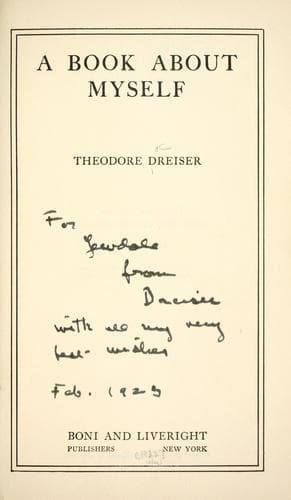
Dreiser, Theodore, 1871-1945; Journalists -- United States -- Biography; Novelists, American -- 20th century -- Biography
Mere money, often unworthily inherited or made by shabby methods, seemed
to throw commonplace and even wretched souls into such glittering and
condescending prominence, in this world at least. Many of the business
men with whom I came in contact were vulgarians, their wives and
daughters vain and coarse and inconsiderate. I was constantly impressed
by the airs of the locally prominent, their craving for show and
pleasure, their insane greed for personal mention, their hearty
indifference to anything except money plus a keen wish to seem to
despise it. I remember going one afternoon to an imposing residence
where some function was in progress. I was met by an ostentatious butler
who exclaimed most nobly: “My dear sir, who sent you here? The _Globe_
knows we never give lists to newspaper men. We never admit reporters,”
and then stiffly closed the door on me. I reported as much to the city
editor, who remarked meekly, “Well, that’s all right,” and gave me
something else to do. But the next day a list of the guests at this
function was published, and in this paper. I made inquiry of Hartung,
who said: “Oh, the society editor must have turned that in. These
society women send in their lists beforehand and then say they don’t
receive reporters.”
Another time it was the residence of the Catholic archbishop of St.
Louis, a very old but shrewd man whom, so it was rumored in newspaper
circles, the local priests were plotting to make appear infirm and
weakminded in order that a favorite of theirs might be made coadjutor. I
was sent to inquire about his health, to see him if possible. At the
door I was met by a sleek dark priest who inquired what I wished,
whereupon he assured me that the archbishop was too feeble to be seen.
“That is exactly why I am here,” I insisted. “The _Globe_ wishes to
inform the public of his exact condition. There seems to be a belief on
the part of some that he is not as ill as is given out.”
“What! You accuse us of concealing something in connection with the
archbishop! This is outrageous!” and he firmly shut me out.
It seemed to me that the straightforward thing would have been to let me
meet the archbishop. He was a public official, the state of whose health
was of interest to thousands. But no; official control regulated that.
Shortly afterward he was declared too feeble to perform his duties and a
coadjutor was appointed.
Again I was sent to a fashionable west end hotel to interview a visiting
governor who was attending a reception of some kind and who, as we
understood, was leaving the next day.
“My dear young fellow,” said a functionary connected with the
entertainment committee, “you cannot do anything of the sort. This is no
time to be coming around for anything of this kind.”
“But he is leaving tomorrow....”
“I cannot help that. You cannot see him now.”
“How about taking him my card and asking him about tomorrow?”
Public-domain text, read in full here on John Shaqi.
Reviews
Reviews
No reviews yet
Be the first to share your thoughts on this work.
Elsewhere in the archive
Join the Discussion
Join the discussion
Sign in to leave a comment or review.
Sign InorCreate an account