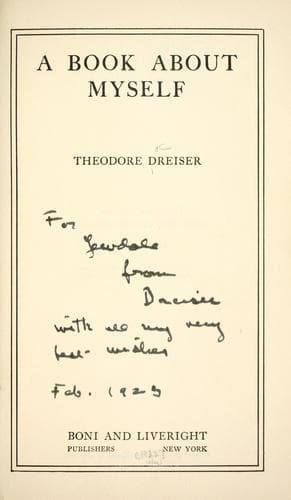
Dreiser, Theodore, 1871-1945; Journalists -- United States -- Biography; Novelists, American -- 20th century -- Biography
I could scarcely believe my eyes or my senses. My hair rose on end. My
hands twitched convulsively. I ran forward, pulling off my coat, and
threw it over him to smother the spots of flame—but it was of no use—my
coat began to burn. With my bare hands I tore grass and earth from the
ditch and piled them upon the sufferer. For the moment I was beside
myself with terror and misery and grief. Tears came to my eyes and I
choked with the sense of helpless misery. When I saw my own coat burning
I snatched it away and stamped the fire out.
The man was burned beyond recovery. The oil had evidently fallen in a
mass upon the back of his head and shoulders and back and legs. It had
burnt his clothes and hair and cooked the skin. His hands were scorched
black, as well as his neck and ears and face. Finally he ceased to
struggle and lay still, groaning heavily but unconscious. He was alive,
but that was all.
Oppressed by the horror of it I looked about for help, but seeing many
others in the same plight I realized the futility of further labor here.
I could do nothing more. I had stopped the flames in part, the man’s
rolling in the ditch had done the rest, but to what end! Hope of life
was ridiculous, I could see that plainly. I turned, like a soldier in
battle, and looked after the rest of the people.
To this hour I can see it all—some running over the fields in the
distance away from the now entirely exploded tanks, others approaching
the fallen victims. A house a little beyond the wreck was burning. A
small village, not a thousand feet away, was blazing in spots, bits of
oil having fallen upon the roofs. People were running hither and thither
like ants, bending over and examining prostrate forms.
My first idea of course when I recovered my senses was that I must get
in touch with my newspaper and get it to send an artist—Wood, if
possible—and then get the news. These people here would do as much for
the injured as I could. Why waste my newspaper’s time on them? I ran to
a little road-crossing telegraph station a few hundred feet farther on
where I asked the agent what was being done.
“I’ve sent for a wreck-train,” he replied excitedly. “I’ve telegraphed
the Alton General Hospital. There ought to be a train and doctor here
pretty soon, any minute now.” He looked at his watch. “What more can I
do?”
“Have you any idea how many are killed?”
“I don’t know. You can see for yourself, can’t you?”
“Will you take a message to the _Globe-Democrat_? I want to send for an
artist.”
“I can’t be bothered with anything like that now,” he replied roughly. I
felt that an instant antagonism and caution enveloped him. He hurried
away.
“How am I to do this?” I thought, and then I ran, studying and aiding
with the victims where aid seemed of the slightest use, wondering how I
should ever be able to report all this, and awaiting the arrival of the
hospital and wrecking train.
------------------------------------------------------------------------
Public-domain text, read in full here on John Shaqi.
Reviews
Reviews
No reviews yet
Be the first to share your thoughts on this work.
Elsewhere in the archive
Join the Discussion
Join the discussion
Sign in to leave a comment or review.
Sign InorCreate an account