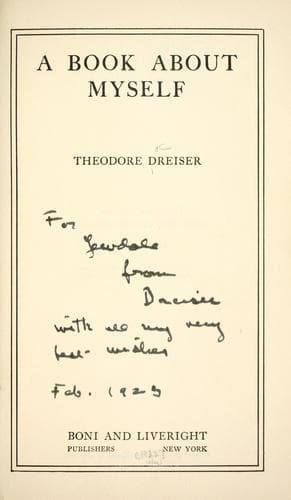
Dreiser, Theodore, 1871-1945; Journalists -- United States -- Biography; Novelists, American -- 20th century -- Biography
I read on down the list of forty or more, and at each name there was a
stir and in some instances cries. As I stepped down two or three people
drew near and thanked me. A flush of gratification swept over me. For
once I felt that I had done something of which I could honestly be
proud.
The rest of the afternoon was spent in gathering outside details. I
hunted up the local paper, which was getting out an extra, and got
permission to read its earlier account. I went to the depot to see how
the trains ran, and by accident ran into Wood. In spite of my inability
to send a telegram the city editor had seen fit to take my advice and
send him. He was intensely wrought up over how to illustrate it all, and
I am satisfied that my description of what had occurred did not ease him
much. I accompanied him back to the hospital to see if there was
anything there he wished to illustrate, and then described to him the
horror as I saw it. Together we visited the morgue of the hospital,
where already fourteen naked bodies had been laid out in a row, bodies
from which the flames had eaten great patches of skin, and I saw that
there was nothing now by which they could be identified. Who were they?
I asked myself. What had they been, done? The nothingness of man! They
looked so commonplace, so unimportant, so like dead flies or beetles.
Curiously enough, the burns which had killed them seemed in some cases
pitifully small, little patches cut out of the skin as if by a pair of
shears, revealing the raw muscles beneath. All those dead were stark
naked, men who had been alive and curiously gaping only two or three
hours before. For once Dick was hushed; he did not theorize or pretend;
he was silent, pale. “It’s hell, I tell you,” was all he said.
On the way back on the train I wrote. In my eagerness to give a full
account I impressed the services of Dick, who wrote for me such phases
of the thing as he had seen. At the office I reported briefly to
Mitchell, giving that solemn salamander a short account of what had
occurred. He told me to write it at full length, as much as I pleased.
It was about seven in the evening when we reached the office, and at
eleven I was still writing and not nearly through. I asked Hartung to
look out for some food for me about midnight, and then went on with my
work. By that time the whole paper had become aware of the importance of
the thing I was doing; I was surrounded and observed at times by gossips
and representatives of out-of-town newspapers, who had come here to get
transcripts of the tale. The telegraph editor came in from time to time
to get additional pages of what I was writing in order to answer
inquiries, and told me he thought it was fine. The night editor called
to ask questions, and the reporters present sat about and eyed me
curiously. I was a lion for once. The realization of my importance set
me up. I wrote with vim, vanity, a fine frenzy.
Public-domain text, read in full here on John Shaqi.
Reviews
Reviews
No reviews yet
Be the first to share your thoughts on this work.
Elsewhere in the archive
Join the Discussion
Join the discussion
Sign in to leave a comment or review.
Sign InorCreate an account