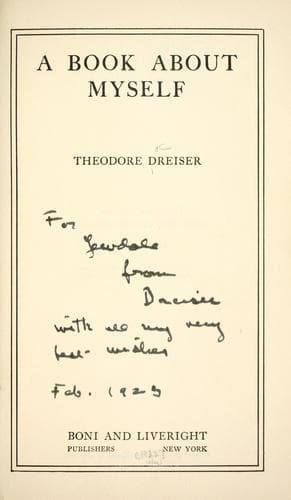
Dreiser, Theodore, 1871-1945; Journalists -- United States -- Biography; Novelists, American -- 20th century -- Biography
But by nightfall, after my copy had been filed, I realized my mistake,
for I received a telegram to return. The local correspondent could
attend to the remaining details. On the way back I began to feel a qualm
of conscience in regard to my conduct. I had been taking a great deal
for granted, as I knew, in thus attempting to act without orders. My
city editor might think I was getting a “swelled head,” as no doubt I
was, and so complain to McCullagh. I knew he did not like me, and this
gave him a good excuse to complain. Besides, my second day’s story, now
that it was gone, did not seem to be so important; I might as well have
carried it in and saved the expense of telegraphing it. I felt that I
had failed in this; also that mature consideration might decide that I
had failed on the first story also. I began to think that by my own
attitude I had worked up all the excitement in the office that Saturday
night and that my editor-in-chief would realize it now and so be
disappointed in me. Suppose, I thought, when I reached the office
McCullagh were dissatisfied and should fire me—then what? Where would I
go, where get another job as good as this? I thought of my various
follies and my past work here. Perhaps with this last error my sins were
now to find me out. “Pride goeth before destruction,” I quoted, “and a
haughty spirit before a fall.”
By eight o’clock, when I reached the office, I was thoroughly depressed
and hurried in, expecting the worst. Of course the train had been
late—had to be on this occasion!—and I did not reach the office in time
to take an evening assignment. Mitchell was out, which left me nothing
to do but worry. Only Hartung was there, and he seemed rather glum.
According to him, Tobe had seemed dissatisfied with my wishing to stay
up there. Why had I been so bold, I asked myself, so silly, so
self-hypnotized? I took up an evening paper and retired gloomily to a
corner to wait. When Mitchell arrived at nine he looked at me but said
nothing. As I was about to go out to get something to eat Hartung came
in and said: “Mr. Mitchell wants to speak to you.”
My heart sank. I went in and stood before him.
“You called for me?”
“Yes. Mr. McCullagh wants to see you.”
“It’s all over,” I thought. “I can tell by his manner. What a fool I was
to build such high hopes on that story!”
I went out to the hall and walked nervously to the office of the chief,
which was at the front end of the hall. I was so depressed I could have
cried. To think that all my fine dreams were to have such an end!
That Napoleon-like creature was sitting in his little office, his chin
on his chest, a sea of papers about him. He did not turn when I entered,
and my heart grew heavier. He was angry with me! I could see it! He kept
his back to me, which was to show me that I was not wanted, done for! At
last he wheeled.
“You called for me, Mr. McCullagh?” I murmured.
Public-domain text, read in full here on John Shaqi.
Reviews
Reviews
No reviews yet
Be the first to share your thoughts on this work.
Elsewhere in the archive
Join the Discussion
Join the discussion
Sign in to leave a comment or review.
Sign InorCreate an account