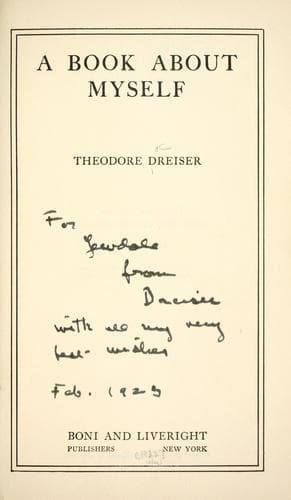
Dreiser, Theodore, 1871-1945; Journalists -- United States -- Biography; Novelists, American -- 20th century -- Biography
“The erudite editor of the _Globe-Democrat_,” observed the
_Post-Dispatch_ editorially, “appears to have visited one of our
principal concert halls last night. It is not often that that ponderous
intellect can be called down from the heights of international politics
to contemplate so simple a thing as a singer of songs, a black one at
that; but when true art beckons even he can be counted upon to answer.
Apparently the Black Patti beckoned to him last evening, and he was not
deaf to her call, as the following magnificent bit of word-painting
fresh from his pen is here to show.” (Then followed the praise in full.)
“None but the grandiloquent editor of the _Globe-Democrat_ could have
looked into the subtleties of nature, as represented by the person of
Miss Sisseretta Jones, and there discovered the wonders of music and
poetry such as he openly confesses to have done. Indeed we have here at
last a measure of that great man’s insight and feeling, a love of art,
music, poetry and the like such as has not previously been indicated by
him. And we hereby hasten to make representation of our admiration and
great debt that others too may not be deprived of this great privilege.”
After this came more of the same gay raillery, with here and there a
reference to “the great patron of the black arts” and the pure joy that
must have been his at thus vicariously being able to enjoy within the
precincts of Exposition Hall “the purling of the waters” bubbling from a
black throat. It was a gentle satire, not wholly uncalled for since the
item had appeared in the _Globe_, and directed at the one man who could
least stand that sort of thing, sensitive as he was to his personal
dignity.
I was blissfully unaware that any comment had been made on my effusion
until about five in the afternoon, by which time the afternoon editions
of the _Post-Dispatch_ had been out several hours. When I entered the
office at five, comfortable and at peace with myself in my new position,
excited comment was running about the office as to what “the old man”
would think and say and do now. He had gone at two, it appeared, to the
Southern for luncheon and had not returned. Wait until he saw it! Oh me!
Oh my! Wouldn’t he be hopping! Hartung, who was reasonably nervous as to
his own share in the matter, was the first to approach and impress me
with the dreadfulness of it all, how savage “the old man” could be in
any such instance. “Gee, just wait! Oh, but he’ll be hot, I bet!” As he
talked the “old man” passed up the hall, a grim and surly figure. I saw
my dramatic honors going a-glimmering.
“Here,” I said to Hartung, pretending a kind of innocence, even at this
late hour, “what’s all this about? What’s the row, anyhow?”
“Didn’t you see the editorial in the _Post-Dispatch_?” inquired Hartung
gloomily. It was his own predicament that was troubling him.
“No. What about?”
Public-domain text, read in full here on John Shaqi.
Reviews
Reviews
No reviews yet
Be the first to share your thoughts on this work.
Elsewhere in the archive
Join the Discussion
Join the discussion
Sign in to leave a comment or review.
Sign InorCreate an account