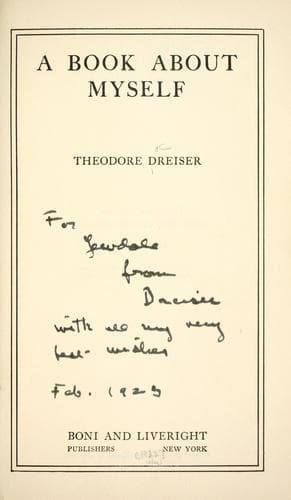
Dreiser, Theodore, 1871-1945; Journalists -- United States -- Biography; Novelists, American -- 20th century -- Biography
WHILE I rejoiced in the thought that I might now, and so easily, become
a successful comic opera librettist, and a poet besides, still I found
myself for the most part in a very gloomy frame of mind. One of the
things that grieved me intensely, as I have said, was the sight of
bitter poverty and failure, and the fact that I personally was not one
of those solid commercial figures of which St. Louis was full at this
time. They filled the great hotels, the clubs, the mansions, the social
positions of importance. They were free, as I foolishly thought, to
indulge in all those luxuries and pleasures which, as I so sadly saw,
the poor were not privileged to enjoy, myself included. Just about that
time there was something about a commercial institution—its exterior
simplicity and bareness, the thrash of its inward life, its suggestion
of energy, force, compulsion and need—which invariably held me
spellbound. Despite my literary and artistic ambitions, I still
continued to think it essential, to me, and to all men for that matter
if they were to have any force and dignity in this world, that each and
every one should be in control of something of this kind, something
commercially and financially successful. And what was I—a pale sprout of
a newspaper man, possibly an editor or author in the future, but what
more?
At times this state of mind tended to make me irritable and even savage
instead of sad. I thought that my very generous benefactor, the great
McCullagh, ought to see what an important man I was and give me at once
the dramatic editorship free and clear of any other work, or at least
combine it with something better than mere reporting. I ought to be
allowed to do editorials or special work. Again, my mind, although
largely freed of Catholic and religious dogma generally and the belief
in the workability of the Christian ideals as laid down in the Sermon on
the Mount, was still swashing around among the idealistic maxims of
Christ and the religionists and moralists generally, contrasting them
hourly, as it were, with the selfish materialism of the day as I saw it.
Look at the strong men at the top, I was constantly saying to myself, so
comfortable, so indifferent, so cruelly dull. How I liked to flail them
with maxims excerpted from Christ! Those large districts south of the
business heart, along the river and elsewhere, which nightly or weekly
Wood, McCord and myself were investigating and which were crowded with
the unfit, the unsuccessful, the unhappy—how they haunted me and how I
attempted (in my mind, of course) to indict society and comfort them
with the poetic if helpless words of the Beatitudes and the Sermon on
the Mount: “Blessed are the poor,” etc. Betimes, interviewing one
important citizen and another, I gained the impression that they truly
despised any one who was poor, that they did not give him or his fate a
second thought; and betimes I was right—other times wrong. But having
Public-domain text, read in full here on John Shaqi.
Reviews
Reviews
No reviews yet
Be the first to share your thoughts on this work.
Elsewhere in the archive
Join the Discussion
Join the discussion
Sign in to leave a comment or review.
Sign InorCreate an account