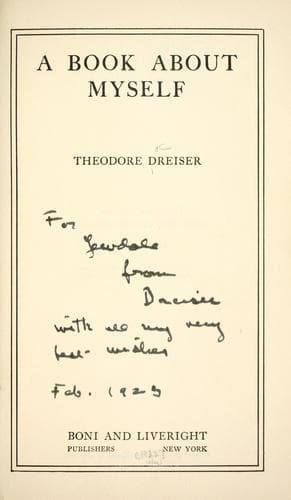
Dreiser, Theodore, 1871-1945; Journalists -- United States -- Biography; Novelists, American -- 20th century -- Biography
“Wandell will think it’s rotten.” But having by now come to a rather
friendly understanding with Williams, I decided to take it over and ask
him so that in case I had failed I might try again.
Wearily he eyed me with his one eye, for already he had been editing
this for days, then leaned back in his chair and began to read it over.
At first he did not seem to be much interested, but after the first
paragraph, which he examined with a blank expression, he smiled and
finally chortled: “This is pretty good, yes. You needn’t worry about it;
I think it’ll do. Leave it with me.” Then he began to edit it. Later in
the afternoon when Wandell had come in to give out the evening
assignments I saw Williams gather it up and go in to him. After a time
he came out smiling, and in a little While Wandell called me in.
“Not bad, not bad,” he said, tapping the manuscript lightly. “You’ve got
the right idea, I think. I’ll let you do that for a while afternoons
until we get up on it. You needn’t do anything else—just that, if you do
it well enough.”
I was pleased, for judging by the time it had taken to do this (not more
than two hours) I should have most of my afternoons to myself. I saw
visions of a late breakfast, idling in my room, walks after I had done
with my work and before I returned to the office. Curiously enough, this
trivial thing, undertaken at first in great doubt and with no sense of
ability and with no real equipment for it, nevertheless proved for me
the most fortunate thing I had thus far done. It was not so much that it
was brilliant, or even especially well done, as that what I did fell in
with the idle summer mood of the city or with the contesting
organizations and the readers of the _Republic_. Congratulatory letters
began to arrive. Pleased individuals whose names had been humorously
mentioned began to call up the city editor, or the managing editor, or
even the editor-in-chief, and voice their approval. In a trice and
almost before I knew it, I was a personage, especially in newspaper
circles.
“We’ve got the stuff now, all right,” Wandell cackled most violently one
evening, at the same time slapping me genially on the shoulder. “This’ll
do it, I’m sure. A few weeks, and we’ll get a big crowd and a lot of
publicity. Just you stick to the way you’re doing this now. Don’t change
your style. We’ve got ’em coming now.”
I was really amazed.
And to add to it, Wandell’s manner toward me changed. Hitherto, despite
his but poorly concealed efforts, he had been distant, brusque,
dictatorial, superior. Now of a sudden he was softer, more confidential.
“I have a friend up the street here—Frank Hewe, an awfully nice fellow.
He’s the second assistant of this or that or the other such company. In
one of these comic blurbs of yours don’t you think you could ring him in
in some way? He’s an Elk and I’m sure the mention would tickle him to
death.”
I saw the point of Mr. Wandell’s good nature. He was handing round some
favors on his own account.
Public-domain text, read in full here on John Shaqi.
Reviews
Reviews
No reviews yet
Be the first to share your thoughts on this work.
Elsewhere in the archive
Join the Discussion
Join the discussion
Sign in to leave a comment or review.
Sign InorCreate an account