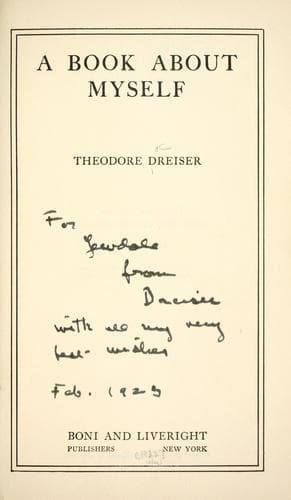
Dreiser, Theodore, 1871-1945; Journalists -- United States -- Biography; Novelists, American -- 20th century -- Biography
“These are the people,” he said. “They are all in one party.” He called
me aside and we sat down, he explaining cheerfully and volubly the
trouble he was having keeping everything in order. I could have murdered
him.
“I’m looking out for the baggage and the hotel bills and all,” he
insisted. “In the morning we’ll be met by a tally-ho and ride out to the
hotel.”
I was thinking of my splendid bevy of girls and the delightful time I
had been having.
“Well, that’ll be fine, won’t it?” I said wearily. “Is that all?”
“Oh, we have it all planned out,” he went on. “It’s going to be a fine
trip.”
I did my best to show that I had no desire to talk, but still he kept
on. He wanted to meet the teachers and I had to introduce him.
Fortunately he became interested in one small group and I sidled
away—only to find my original group considerably reduced. Some had gone
to the dressingroom, others were arranging their parcels about their
unmade berths. The porter came in and began to make them up. I looked
ruefully about me.
“Well, our little group has broken up,” I said at last to the girl of my
choice as I came up to where she was sitting.
“Yes. It’s getting late. But I’m not sleepy yet.”
We dropped into an easy conversation, and I learned that she was from
Missouri and taught in a little town not far from St. Louis. She
explained to me how she had come to win, and I told her how ignorant I
had been of the whole affair up to four days ago. She said that friends
had bought hundreds of _Republics_ in order to get the coupons. It
seemed a fine thing to me for a girl to be so popular.
“You’ve never been to Chicago, then?” I asked.
“Oh no. I’ve never been anywhere really. I’m just a simple country girl,
you know. I’ve always wanted to go, though.”
She fascinated me. She seemed so direct, truthful, sympathetic.
“You’ll enjoy it,” I said. “It’s worth seeing. I was in Chicago when the
Fair was being built. My home is there.”
“Then you’ll stay with your home-folks, won’t you?” she asked, using a
word for family to which I was not accustomed. It touched a chord of
sympathy. I was not very much in touch with my family any more but the
way she seemed to look on hers made me wish that I were.
“Well, not exactly. They live over on the west side. I’ll go to see
them, though.”
I was thinking that now I had her out of that sparkling group she seemed
more agreeable than before, much more interesting, more subdued and
homelike.
She arose to leave me. “I want to get some of my things before the
porter puts them away,” she explained.
I stepped out of her way. She tripped up the aisle and I looked after
her, fascinated. Of a sudden she seemed quite the most interesting of
all those here, simple, pretty, vigorous and with a kind of tact and
grace that was impressive. Also I felt an intense something about her
that was concealed by an air of supreme innocence and maidenly reserve.
I went out to the smokingroom, where I sat alone looking out of the
window.
Public-domain text, read in full here on John Shaqi.
Reviews
Reviews
No reviews yet
Be the first to share your thoughts on this work.
Elsewhere in the archive
Join the Discussion
Join the discussion
Sign in to leave a comment or review.
Sign InorCreate an account