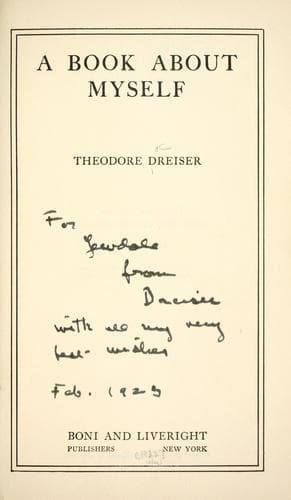
Dreiser, Theodore, 1871-1945; Journalists -- United States -- Biography; Novelists, American -- 20th century -- Biography
I can see him now, a thin grasshopper of a man, brooding wearily with
those black-brown Teutonic eyes of his, as sad as failure itself. What
thoughts! What moods! He was very much like one of those old men whom
Rembrandt has portrayed, wrinkled, sallow, leathery. My father’s
peculiarly German hair and beard were always carefully combed and
brushed, the hair back over his forehead like Nietzsche’s, the beard
resting reddishly on his chest. His clothes were always loose and
ill-fitting, being bought for durability, not style, or made over from
abandoned clothes of some one—my brother Paul or my sister M——’s
husband. He always wore an old and very carefully preserved black derby
hat, very wide of brim and out of style, which he pulled low over his
deep-set weary eyes. I always wondered where and when he had bought it.
On this trip I offered to buy him a new one, but he preferred to use the
money for a mass for the repose of my good mother’s soul! Under his arm
or in one of his capacious pockets was always a Catholic prayerbook from
which he read prayers as familiar to him as his own hands, yet from the
mumbling repetition of which he extracted some comfort, as does the
Hindu from meditating upon space or time. In health he was always
fluttering to one or another of a score of favorite Catholic churches,
each as commonplace as the other, and there, before some trashy plaster
image of some saint or virgin as dead or helpless as his own past,
making supplication for what?—peace in death, the reconversion and right
conduct of his children, the salvation of his own and my mother’s soul?
Debts were his great misery, as I had always known. If one died and left
unpaid an old bill of some kind one had to stay in purgatory so much
longer!
Riding into Chicago this morning I speculated as to the thinness of his
hands as I had known them, the tremulousness of his inquiries, the
appeal in his sad resigned eyes, whence all power to compel or convince
had long since gone. In the vast cosmic flight of force, flowing from
what heart we know not but in which as little corks our suns and planets
float, it is possible that there may be some care, an equation, a
balancing of the scales of suffering and pleasure. I hope so. If not I
know not the reason for tears or those emotions with which so many of us
salve the memory of seemingly immedicable ills. If immedicable, why cry?
I sought Miss W——, who was up before me and sitting beside her section
window. I was about to go and talk with her when my attention was
claimed by other girls. This bevy could not very well afford to see the
attention of the only man on board so easily monopolized. There were so
many pretty faces among them that I wavered. I talked idly among them,
interested to see what overtures and how much of an impression I might
make. My natural love of womankind made them all inviting.
Public-domain text, read in full here on John Shaqi.
Reviews
Reviews
No reviews yet
Be the first to share your thoughts on this work.
Elsewhere in the archive
Join the Discussion
Join the discussion
Sign in to leave a comment or review.
Sign InorCreate an account