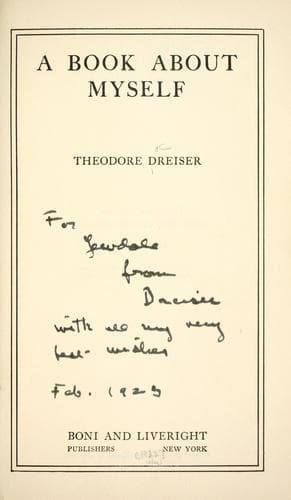
Dreiser, Theodore, 1871-1945; Journalists -- United States -- Biography; Novelists, American -- 20th century -- Biography
have often thought since how those pessimists who up to that time had
imagined that nothing of any artistic or scientific import could
possibly be brought to fruition in America, especially in the middle
West, must have opened their eyes as I did mine at the sight of this
realized dream of beauty, this splendid picture of the world’s own hope
for itself. I have long marveled at it and do now as I recall it, its
splendid Court of Honor, with its monumental stateliness and simple
grandeur; the peristyle with its amazing grace of columns and sculptured
figures; the great central arch with its triumphal quadriga; the dome of
the Administration Building with its daring nudes; the splendid
groupings on the Agricultural Building, as well as those on the
Manufacturers’ and Women’s buildings. It was not as if many minds had
labored toward this great end, or as if the great raw city which did not
quite understand itself as yet had endeavored to make a great show, but
rather as though some brooding spirit of beauty, inherent possibly in
some directing over-soul, had waved a magic wand quite as might have
Prospero in _The Tempest_ or Queen Mab in _A Midsummer Night’s Dream_,
and lo, this fairyland.
In the morning when I came down from my room I fell in with Miss W—— in
the diningroom and was thrilled by the contact. She was so gay,
good-natured, smiling, unaffected. And with her now was a younger sister
of whom I had not heard and who had come to Chicago by a different route
to join her. I was promptly introduced, and we sat down at the same
table. It was not long before we were joined by the others, and then I
could see by the exchange of glances that it was presumed that I had
fallen a victim to this charmer of the night before. But already the
personality of the younger sister was appealing to me quite as much as
the elder. She was so radiant of humor, freckled, plump, laughing and
with such an easy and natural mode of address. Somehow she struck me as
knowing more of life than her sister, being more sophisticated and yet
quite as innocent.
After breakfast the company broke up into groups of two and three. Each
had plans for the day and began talking them over.
We started off finally for the Fair gate and on the way I had an
opportunity to study some of the other members of the party and make up
my mind as to whether I really preferred her above all. Despite my
leaning toward Miss W—— I now discovered that there was a number whose
charms, if not superior to those of Miss W——, were greater than I had
imagined, while some of those who had attracted me the night before were
being modified by little traits of character or mannerism which I did
not like. Among them was one rosy black-haired Irish girl whose solid
beauty attracted me very much. She was young and dark and robust, with
the air of a hoyden. I looked at her, quite taken by her snapping black
eyes, but nothing came of it for the moment: we were all becoming
interested in the Fair.
Public-domain text, read in full here on John Shaqi.
Reviews
Reviews
No reviews yet
Be the first to share your thoughts on this work.
Elsewhere in the archive
Join the Discussion
Join the discussion
Sign in to leave a comment or review.
Sign InorCreate an account