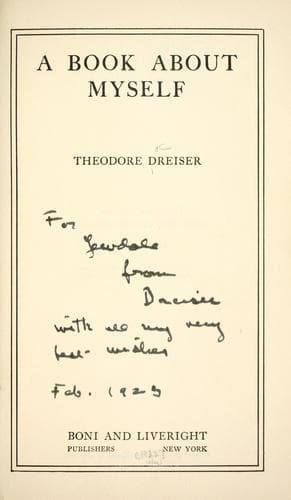
Dreiser, Theodore, 1871-1945; Journalists -- United States -- Biography; Novelists, American -- 20th century -- Biography
Now this thing, when actually worked out under my very eyes and with
myself doing the thinking, astounded me and caused me to ponder the
mysteries of life more than ever. How could another man read my mind
like that? What was it that perceived and interpreted my thoughts? It
gave me an immense kick mentally, one that stays by me to this day, and
set me off eventually on the matters of psychology and chemic mysteries
generally. When this was written up as true, as it was, it made a
splendid story and attracted a great deal of attention. Once and for
all, it cleared up my thoughts as to the power of mind over so-called
matter and caused this “committee” to enter upon experiments of its own
with hypnotists, spiritualists and the like, until we were fairly well
satisfied as to the import of these things. I myself stood on the
stomach of a thin hypnotized boy of not more than seventeen years of
age, while his head was placed on one chair, his feet on another and no
brace of any kind was put under his body. Yet his stomach held me up.
But, having established the truth of such things for ourselves, we found
no method of doing anything with our knowledge. It was practically
useless in this region, and decidedly taboo.
Another individual who interested me quite as might a book or story was
a Spiritualist, a fat, sluglike Irish type, who came to town about this
time and proved to be immensely successful in getting up large meetings,
entrance to which he charged. Soon there were ugly rumors as to the
orgiastic character of his séances, especially at his home where he
advertised to receive interested spiritualists in private. One day my
noble and nosy city editor set me to the task of ferreting out all this,
with the intention of _sicking_ the moralists on the gentleman and so
driving him out of town. Was it because Mr. Wandell, interested in
morals or at least responding to the local sentiment for a moral city,
considered this man a real menace to St. Louis and so wished to be rid
of him? Not at all. Mr. Wandell cared no more for Mr. Mooney or the
public or its subsurface morals than he cared for the politics of
Beluchistan. In the heart of St. Louis at this very time, in Chestnut
Street, was a large district devoted to just such orgies as this
stranger was supposed to be perpetrating; but this area was never in the
public eye, and you could not, for your life, put it there. The public
apparently did not want it attacked, or if it did there were forces
sufficiently powerful to keep it from obtaining its wishes. The police
were supposed to extract regular payments from one and all in this area,
as Rodenberger, in the little paper he ran, frequently charged, but this
paper had no weight. The most amazing social complications occasionally
led directly to one or another of these houses, as I myself had seen,
but no comment was ever made on the peculiarity of the area as a whole
or its persistence in the face of so much moral sentiment. The vice
Public-domain text, read in full here on John Shaqi.
Reviews
Reviews
No reviews yet
Be the first to share your thoughts on this work.
Elsewhere in the archive
Join the Discussion
Join the discussion
Sign in to leave a comment or review.
Sign InorCreate an account