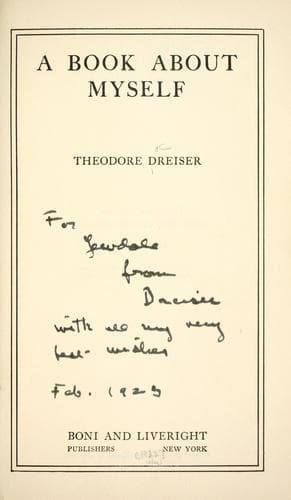
Dreiser, Theodore, 1871-1945; Journalists -- United States -- Biography; Novelists, American -- 20th century -- Biography
He eyed me with a nervous uncertainty that was almost tremulous. He did
not seem to be able to speak at first but chewed on something, a bit of
tobacco possibly.
“Not so loud,” he said. “Come out here. I’ll give you ten dollars if you
won’t say anything about this,” and he began to fumble in one of his
waistcoat pockets.
“No, no,” I said, with an air of profound virtue. “I can’t take money
for anything like that. I can’t stop anything the paper may want to say.
You’ll have to see the editor.”
All the while I was thinking how like an old fox he was and that if one
did have the power to suppress a story of this kind here was a fine
opportunity for blackmail. He might have been made to pay a thousand or
more. At the same time I could not help sympathizing with him a little,
considering his age and his unfortunate predicament. Of late I had been
getting a much clearer light on my own character and idiosyncrasies as
well as on those of many others, and was beginning to see how few there
were who could afford to cast the stone of righteousness or superior
worth. Nearly all were secretly doing one thing and another which they
would publicly denounce and which, if exposed, would cause them to be
shunned or punished. Sex vagaries were not as uncommon as the majority
supposed and perhaps were not to be given too sharp a punishment if
strict justice were to be done to all. Yet here was I at this moment
yelping at the heels of this errant, who had been found out. At the same
time I cannot say that I was very much moved by the personality of the
man: he looked to be narrow and close-fisted. I wondered how a business
man of any acumen could be connected with so shabby an affair, or being
caught could be so dull as to offer any newspaper man so small a sum as
ten dollars to hush it up. And how about the other papers, the other
reporters who might hear of it—did he expect to buy them all off for ten
dollars each? The fact that he had admitted the truth of the charges
left nothing to say. I felt myself grow nervous and incoherent and
finally left rather discomfited and puzzled as to what I should do. When
I returned to the office and told Wandell he seemed to be rather dubious
also and more or less disgusted.
“You can’t make much out of a case of that kind,” he said. “We couldn’t
print it if you did; the public wouldn’t stand for it. And if you attack
the police for concealing it then they’ll be down on us. He ought to be
exposed, I suppose, but—well——Write it out and I’ll see.”
I therefore wrote it up in a wary and guarded way, telling what had
happened and how the police had not entered the charge, but the story
never appeared. Somehow, I was rather glad of it, although I thought the
man should be punished.
------------------------------------------------------------------------
CHAPTER XLIV
Public-domain text, read in full here on John Shaqi.
Reviews
Reviews
No reviews yet
Be the first to share your thoughts on this work.
Elsewhere in the archive
Join the Discussion
Join the discussion
Sign in to leave a comment or review.
Sign InorCreate an account