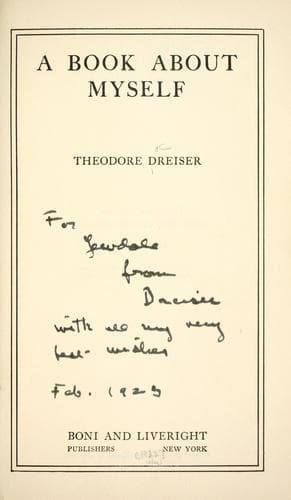
Dreiser, Theodore, 1871-1945; Journalists -- United States -- Biography; Novelists, American -- 20th century -- Biography
The man returned to his task as stevedore, working his way from one
river city to another. When he came to Memphis, Natchez, New Orleans,
Vicksburg or St. Louis, he disguised himself as a peddler selling
trinkets and charms and in this capacity walked the crowded negro
sections of these cities calling his wares. One of these trips finally
brought him to St. Louis, and here on a late August afternoon, ambling
up this stifling little alley calling out his charms and trinkets, he
had finally encountered her. The girl put her head out of the doorway.
Dropping his tray he drew a razor and slashed her cheeks and lips, arms,
legs, back and sides, so that when I arrived at the City Hospital she
was unconscious and her life despaired of. The lover, abandoning his
tray of cheap jewelry, which was later brought to the stationhouse and
exhibited, had made good his escape and was not captured, during my stay
in St. Louis at least. Her present paramour had also gone his way,
leaving her to suffer alone.
Owing possibly to Galvin’s underestimate of its romance, this story
received only a scant stick as a low dive cutting affray in the
_Globe-Democrat_, while in the _Republic_ I had turned it into a negro
romance which filled all of a column. Into it I had tried to put the hot
river waterfronts of the different cities which the lover had visited,
the crowded negro quarters of Memphis, New Orleans, Cairo, the bold
negro life which two truants such as the false mistress and her lover
might enjoy. I had tried to suggest the sing-song sleepiness of the
levee boat-landings, the stevedores at their lazy labors, the idle,
dreamy character of the slow-moving boats. Even an old negro refrain
appropriate to a trinket peddler had been introduced:
“Eyah—Rings, Pins, Buckles, Ribbons!”
The barbaric character of the alley in which it occurred, lined with
rickety curtain-hung shacks and swarming with the idle, crooning,
shuffling negro life of the South, appealed to me. An old black mammy
with a yellow-dotted kerchief over her head, who kept talking of “disha
Gawge” and “disha Sam” and “disha Maquatia” (the girl), moved me to a
poetic frenzy. From a crowd of blacks that hung about the vacated shack
of the lovers after the girl had been taken away I picked up the main
thread of the story, the varying characteristics of the girl and her
lover, and then having visited the hospital and seen the victim I
hurried to the office and endeavored to convince Wandell that I had an
important story. At first he was not inclined to think so, negro life
being a little too low for local consumption, but after I had entered
upon some of the details he told me to go ahead. I wrote it out as well
as I could, and it went in on the second page. The next day, meeting
Galvin, having first examined the _Globe_ to see what had been done
there, I beamed on him cheerfully and was met with a snarl of rage.
Public-domain text, read in full here on John Shaqi.
Reviews
Reviews
No reviews yet
Be the first to share your thoughts on this work.
Elsewhere in the archive
Join the Discussion
Join the discussion
Sign in to leave a comment or review.
Sign InorCreate an account