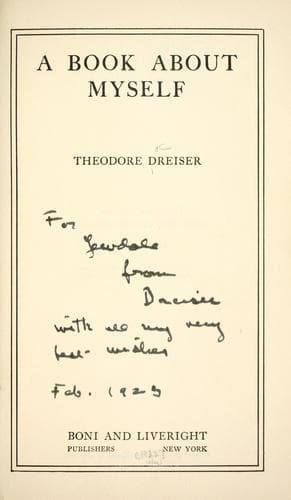
Dreiser, Theodore, 1871-1945; Journalists -- United States -- Biography; Novelists, American -- 20th century -- Biography
“Yes, sir,” I said. I was so pleased and flattered to think that he
should trouble to talk to me at all or to indicate that he knew where I
was that I could scarcely contain myself. I wanted to thank him, to
apologize, to tell him how wonderful he was to me and what a fool I was
in my own estimation, but I couldn’t. My tongue was thick.
“You like it over there?”
“Yes, sir. Fairly well, sir.” I was as humble in his presence as a
jackie is before an officer. He seemed always so forceful and
commanding.
“That little matter of those theaters,” he began after a pause, turning
and walking back to his chair, I following, “—Um! um! I don’t think you
understand quite how I felt about that. I was sorry to see you go. Um!
um!” and he cleared his throat. “It was an unfortunate mistake all
around. I want you to know that I did not blame you so much. Um! You
might have been relieved of other work. I don’t want to take you away
from any other paper, but—um!—I want you to know that if you are ever
free and want to come back you can. There is no prejudice in my mind
against you.”
I don’t know of anything that ever moved me more. It was wonderful,
thrilling. I could have cried from sheer delight. He, my chief, saying
this to me! And after all those wretched hours! What a fool I was, I now
thought, not to have gone to him personally then and asked his
consideration. However, as I saw it, it was too late. Why change now and
go back? But I was so excited that I could scarcely speak, and probably
would not have known what to say if I had tried. I stood there, and
finally blurted out:
“I’m very sorry, Mr. McCullagh. I didn’t mean to do what I did. It was a
mistake. I had that extra assignment and—”
“O-oh, that’s all right—that’s all right,” he insisted gruffly and as if
he wished to be done with it once and for all. “No harm done. I didn’t
mind that so much. But you needn’t have left—that’s what I wish you to
understand. You could have stayed if you had wanted to.”
As I viewed it afterward, my best opportunity for a secure position in
St. Louis was here. If I had only known it, or, knowing, had been quick
to take advantage of it, I might have profited greatly. Mr. McCullagh’s
mood was plainly warm toward me; he probably looked upon me as a foolish
and excitable but fairly capable boy whom it would have been his
pleasure to assist in the world. He had brought me from Chicago; perhaps
he wished me to remain under his eye.... Plainly, a word, and I could
have returned, I am sure of it, perhaps never to leave. As it was,
however, I was so nervous and excited that I took no advantage of it.
Possibly he noticed my embarrassment and was pleased. At any rate, as I
mumbled my thanks and gratitude for all he had done for me, saying that
if I were doing things over I should try to do differently, he
interrupted me with:
Public-domain text, read in full here on John Shaqi.
Reviews
Reviews
No reviews yet
Be the first to share your thoughts on this work.
Elsewhere in the archive
Join the Discussion
Join the discussion
Sign in to leave a comment or review.
Sign InorCreate an account