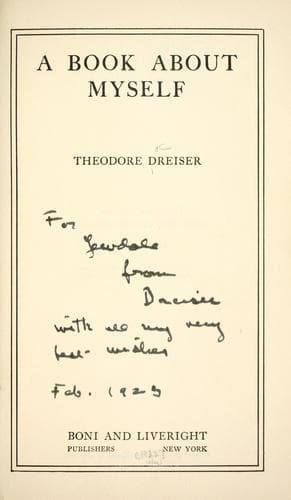
Dreiser, Theodore, 1871-1945; Journalists -- United States -- Biography; Novelists, American -- 20th century -- Biography
Here I was dreaming of all the excellencies of which the
conventionalists prate in connection with home, peace, stability and the
like, anxious to put my neck under that yoke, when in reality what I
really wanted, and the only thing that my peculiarly erratic and
individual disposition would permit, was mental and personal freedom. I
did not really want any such conventional girl at all, and if I had
clearly understood what it all meant I might have been only too glad to
give her up. What I wanted was the joy of possessing her without any of
the hindrances or binding chains of convention and monogamy, but she
would none of it. This unsatisfied desire, added to a huge world-sorrow
over life itself, the richness and promise of the visible scene, the
sting and urge of its beauty, the briefness of our days, the uncertainty
of our hopes, the smallness of our capacity to achieve or consume where
so much is, produced an intense ache and urge which endured until I left
St. Louis. I was so staggered by the promise and the possibilities of
life, at the same time growing more and more doubtful of my capacity to
achieve anything, that I was falling into a profound sadness. Yet I was
only twenty-two, and between these thoughts would come intense waves of
do and dare: I was to be all that I fancied, achieve all that I dreamed.
As a contrast to all these thoughts, fancies, and depressions, I
indulged in a heavy military coat of the most disturbing length, a
wide-brimmed Stetson hat, Southern style, gloves, a cane, soft pleated
shirts—a most _outré_ equipment for all occasions including those on
which I could call upon her or take her to a theater or restaurant. I
remember one Saturday morning, when I was on my way to see my lady love
and had stopped at the Olympic to secure two seats, meeting a dapper,
rather flashy newspaper man. I had on the military coat, and the hat, a
pair of bright yellow gloves, narrow-toed patent leather shoes, a ring,
a pin, a suit brighter than his own, a cane, and I was carrying a
bouquet of roses. I was about to take a street-car out to her place, not
being prosperous enough to hire a carriage.
“Well, for sake, old man, what’s up?” he called, seizing me by the arm.
“You’re not getting married, are you?”
“Aw, cut the comedy!” I replied, or words to that effect. “Can’t a
fellow put on any decent clothes in this town without exciting the
natives? What’s wrong?”
“Nothing, nothing,” he replied apologetically. “You look swell. You got
on more dog than ever I see a newspaper man around here pull. You must
be getting along! How are things at the _Republic_, anyhow?”
We now conversed more affably. He touched the coat gingerly and with
interest, felt of the quality of the cloth, looked me up and down,
seemingly with admiration—more likely with amazement—shook his head
approvingly and said: “Some class, I must say. You’re right there,
sport, with the raiment,” and walked off.
Public-domain text, read in full here on John Shaqi.
Reviews
Reviews
No reviews yet
Be the first to share your thoughts on this work.
Elsewhere in the archive
Join the Discussion
Join the discussion
Sign in to leave a comment or review.
Sign InorCreate an account