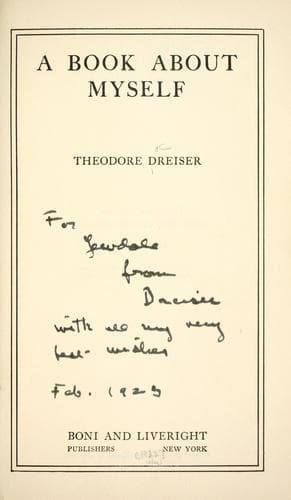
Dreiser, Theodore, 1871-1945; Journalists -- United States -- Biography; Novelists, American -- 20th century -- Biography
The car in which the murder had been committed was here in the barn. The
blood-stains of the victim were still to be seen on the floor. I took
this car, which was now carrying a group of detectives, a doctor and
some other officials, to the dead man’s house, or to the house of the
girl, I forget which. When I arrived there I discovered that a large
comfortable residence some little distance beyond the home of the dead
man was the scene of all news and activity, for here it was that the
body of the conductor had been carried, and from here the girl had taken
a horse and ridden far and wide to call others to her aid. When I
hurried up to the door she had returned and was holding a sort of levee.
The large livingroom was crowded, and in the center, under the flare of
a hanging lamp, was this maiden, rather pretty, with her hair brushed
straight back from her forehead, and her face alight with the intensity
of her recent experiences and actions. I drew near and surveyed her over
the shoulders of the others as she talked, finally getting close enough
to engage her in direct conversation, as was my duty. She was very
simple in manner and speech—not quite the dashing heroine I had imagined
yet attractive enough. For my benefit, and possibly for the dozenth
time, she narrated all that had befallen her from the time she boarded
the car until she had leaped from the front step after the shot and hid
in the wood, finding her way to this house eventually and borrowing a
horse to notify others, because, for one thing, there was no telephone
here, and for another there was no man at home at the time who could
have gone for her. With a kind of naïf enthusiasm she explained to me
that once the shot had been fired and the conductor had fallen face down
in the car (he had come in to rebuke these boisterous blacks, who were
addressing bold remarks to her), she was cold with fright, but that
after she had left the car she felt calmer and determined to do
something to aid in the capture of the murderers. Hiding behind bushes,
she had seen the negroes dash out of the rear door of the car and run
back along the track into the darkness, and had then hurried in the
other direction, coming to this house and summoning aid.... It was a
fine story, her ride in the darkness and how people rose to come out and
help her. I made copious notes in my mind, took her name and address,
visited the conductor’s wife, who was a little distance away, and then
hurried to the nearest telephone to communicate my news.
During this conversation with the girl I made an impression on her. As
we talked I had drawn quite close and my enthusiasm for her deed had
drawn forth various approving smiles and exclamations. When I took her
address I said I should like to know more of her, and she smiled and
said: “Well, you can see me any time tomorrow.” This was Saturday night.
Public-domain text, read in full here on John Shaqi.
Reviews
Reviews
No reviews yet
Be the first to share your thoughts on this work.
Elsewhere in the archive
Join the Discussion
Join the discussion
Sign in to leave a comment or review.
Sign InorCreate an account