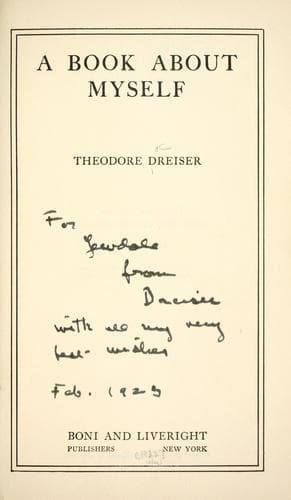
Dreiser, Theodore, 1871-1945; Journalists -- United States -- Biography; Novelists, American -- 20th century -- Biography
“My boy!” he used to say to me, with a fat and yet wholly impressive
vehemence that I could not help admiring whether I agreed with him or
not, “that character of Jean Valjean is one of the greatest in the
world—a masterpiece—and I’ll tell you why—” and he would then begin to
enlarge upon the moral beauty of Valjean carrying the wounded Marius
through the sewer, his taking up and caring for the poor degraded
mother, abandoned by the students of Paris, his gentle and forgiving
attitude toward all poverty and crime.
The amusing thing about all this was, of course, that in the next breath
he would reiterate that all men were dogs and thieves, that in all cases
one had to press one’s advantage to the limit and trust nobody, that one
must burn, cut, slay, if one wished to succeed. Once I said to him,
still under the delusion that the world might well be full of
tenderness, charity, honesty and the like: “John, you don’t really
believe all that. You’re not as hard as you say.”
“The hell I’m not! The trouble with you is that you don’t know me.
You’re just a cub yet, Theodore,” and his face wore that adorable, fat,
cynical smirk, “full of college notions of virtue and charity, and all
that guff. You think that because I helped you a little in Chicago all
men are honest, kind, and true. Well, you’ll have to stow that pretty
soon. You’re getting along now, and whatever you think other people
ought to do you’ll find it won’t be very convenient to do it
yourself—see?” And he smirked angelically once more. To me, in spite of
what he said, he seemed anything but hard or mean.
Public-domain text, read in full here on John Shaqi.
Reviews
Reviews
No reviews yet
Be the first to share your thoughts on this work.
Elsewhere in the archive
Join the Discussion
Join the discussion
Sign in to leave a comment or review.
Sign InorCreate an account