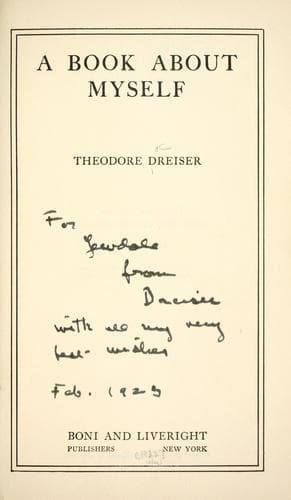
Dreiser, Theodore, 1871-1945; Journalists -- United States -- Biography; Novelists, American -- 20th century -- Biography
I told him what I knew of St. Louis, how things went generally, and
offered to give him letters or personal introductions to McCullagh, a
managing editor on the _Chronicle_, to Wandell, and several others. He
thanked me, and then I invited him to come and live in my room, which he
declined at the time, taking instead a room next door to mine on the
same floor—largely because it was inexpensive and central and not, I am
sure, because it was near me. Here he stayed nearly a month, during
which time he doubtless made efforts to find something to do, which I
also did. Suddenly he was gone, and a little later, and much to my
astonishment, Dunlap informed me that he had concluded that I had been
instrumental in keeping him from obtaining work here! This he had
deduced not so much from anything he knew or had heard, but by some
amazing process of reversal; since I was much beholden to him and in a
position to assist him, I, by some perversion of nature, would resent
his coming and would do everything in my power to keep him out!
No event in my life ever gave me a queerer sense of being misunderstood
and defeated. Of all the people I knew, I would rather have aided
Maxwell than any one else. Because I felt so sure that I could not
recommend him for anything good enough for him, I felt ashamed to try. I
did the little I could, but after a while he left without bidding me
good-by.
But before he went there were many gatherings in his room or mine, and
always he assumed the same condescending and bantering tone toward me
that he had used in Chicago, which made me feel as though he thought my
present standing a little too good for me. And yet at times, in his more
cheerful moods, he seemed the same old John, tender, ranting, filled
with a sincere desire for the welfare of any untutored beginner, and
only so restless and irritable now because he was meshed in financial
difficulties.
At that, he attempted to do me one more service, which, although I did
not resent it very much, I completely misunderstood. This was in regard
to Miss W——, whose photograph he now saw and whose relation to me he
gathered to be serious, although what he said related more to my whole
future than to her. One day he walked into my room and saw the picture
of my love hanging on the wall. He paused first to examine it.
“Who’s this?” he inquired curiously.
I can see him yet, without coat or waistcoat, suspenders down, his fat
stomach pulled in tightly by the waistband of his trousers, his fat face
pink with health, his hair tousled on his fine round head.
“That’s the girl I’m engaged to,” I announced proudly. “I’m going to
marry her one of these days when I get on my feet.” Then, lover-like, I
began to expatiate on her charms, while he continued to study the
photograph.
“Have you any idea how old she is?” he queried, looking up with that
queer, cynical, unbelieving look of his.
“Oh, about my age.”
Public-domain text, read in full here on John Shaqi.
Reviews
Reviews
No reviews yet
Be the first to share your thoughts on this work.
Elsewhere in the archive
Join the Discussion
Join the discussion
Sign in to leave a comment or review.
Sign InorCreate an account