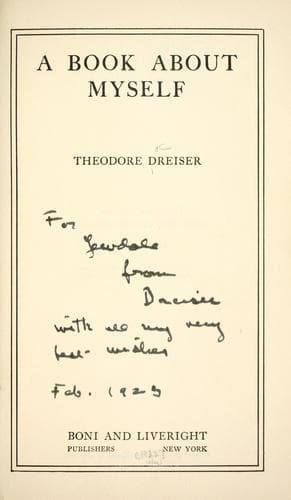
Dreiser, Theodore, 1871-1945; Journalists -- United States -- Biography; Novelists, American -- 20th century -- Biography
AS I look back upon my life now I realize clearly that of all the
members of our family subsequent to my mother’s death, the only one who,
without quite understanding me, still sympathized with my intellectual
and artistic point of view—and that most helpfully and at times
practically—was my brother Paul. Despite the fact that all my other
brothers were much better able intellectually than he to appreciate the
kind of thing I was tending toward mentally, his was the sympathy that
buoyed me up. I do not think he understood, even in later years (long
after I had written _Sister Carrie_, for instance), what I was driving
at. His world was that of the popular song, the middle-class actor or
comedian, the middle-class comedy, and such humorous esthetes of the
writing world as Bill Nye, Petroleum V. Nasby, and the authors of the
_Spoopendyke Papers_ and _Samantha at Saratoga_. As far as I could make
out—and I say this in no lofty, condescending spirit—he was full of
simple middle-class romance, middle-class humor, middle-class
tenderness, and middle-class grossness—all of which I am very free to
say I admire. After all, we cannot all be artists, statesmen, generals,
thieves or financiers. Some of us, the large majority, have to be just
plain everyday middle-class, and a very comfortable state it is under
any decent form of government.
But there is so very much more to be said of him, things which
persistently lift him in my memory to a height far more appealing and
important than hundreds of greater and surer fame. For my brother was a
humorist of so tender and delicate a mold that to speak of him as a mere
middle-class artist or middle-class thinker and composer, would be to do
him a gross injustice and miss the entire significance and flavor of his
being. His tenderness and sympathy, a very human appreciation of the
weakness and errors as well as the toils and tribulations of most of us,
was his most outstanding and engaging quality and gave him a very
definite force and charm. Admitting that he had an intense, possibly an
undue fondness for women (I have never been able to discover just where
the dividing line is to be drawn in such matters), a frivolous,
childish, horse-play sense of humor at times, still he had other
qualities that were positively adorable. That sunny disposition, that
vigorous, stout body and nimble mind, those smiling sweet blue eyes,
that air of gayety and well-being that was with him nearly all the time,
even at the most trying times! Life seemed to bubble in him. Hope sprang
upward like a fountain. You felt in him a capacity to do (in his limited
field), an ability to achieve, whether he was succeeding at the moment
or not. Never having the least power to interpret anything in a high
musical way, still he was always full of music of a tender, sometimes
sad, sometimes gay kind, the ballad-maker of a nation. For myself, I was
always fascinated by this skill of his, the lovable art that attempts to
Public-domain text, read in full here on John Shaqi.
Reviews
Reviews
No reviews yet
Be the first to share your thoughts on this work.
Elsewhere in the archive
Join the Discussion
Join the discussion
Sign in to leave a comment or review.
Sign InorCreate an account