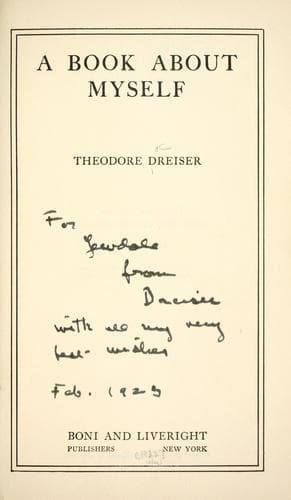
Dreiser, Theodore, 1871-1945; Journalists -- United States -- Biography; Novelists, American -- 20th century -- Biography
Sunday morning came, and I called at the theater at about eleven, and
found him on the stage of this old theater entirely surrounded by trunks
and scenery. There was with him at the moment a very petite actress, the
female star of the company, who, as I later learned, was one of his
passing flames. He was stout as ever, and dressed in the most engaging
Broadway fashion: a suit of good cloth and smart cut, a fur coat, a high
hat and a gold-headed cane—in short, all the earmarks of prosperity and
comfort. What a wonderful thing he and this stage world, even this world
of claptrap melodrama, seemed to me at the time. I felt on the instant
somehow as though I were better established in the world than I thought,
to be thus connected with one who traveled all over the country. The
whole world seemed to come closer because of him.
“Hello!” he called, plainly astonished. “Where’d you come from?” and
then seeing that I was better dressed and poised mentally than he had
ever known me, he looked me over in an odd, slightly doubting way, as a
stranger might, and then introduced me to his friend. Seeing him
apparently pleased by my arrival and eager to talk with me, she quickly
excused herself, saying she had to go on to her hotel; then he fell to
asking me questions as to how I came to be here, how I was getting
along. I am sure he was slightly puzzled and possibly disturbed by my
sharp change from a shy, retiring boy to one who examined him with the
chill and weighing eye of the newspaper man. To me, all of a sudden, he
was not merely one whom I had to like because he was my brother or one
who knew more about life than I—rather less, I now thought, quickly
gathering his intellectual import, but because of his character solely.
I might like or dislike that as I chose. He reminded me now a great deal
of my mother, and I could not help recalling how loving and generous he
had always been with her. Instantly he appealed to me as the simple,
home-loving mother-boy that he was. It brought him so close to me that I
was definitely and tenderly drawn to him. I could feel how fine and
generous he really was. Even then although I doubt very much whether he
liked me at first, finding me so brash and self-sufficient, still, so
simple and communistic were the laws by which his charming mind worked,
he at once accepted me as a part of the family and so of himself, a
brother, one of mother’s boys. How often have I heard him say in regard
to some immediate relative concerning whom an acrimonious debate might
be going forward, “After all, he’s your brother, isn’t he?” or “She’s
your sister,” as though mere consanguinity should dissolve all
dissatisfactions and rages! Isn’t there something humanly sweet about
that, in the face of all the cold, decisive conclusions of this world?
------------------------------------------------------------------------
CHAPTER LIII
Public-domain text, read in full here on John Shaqi.
Reviews
Reviews
No reviews yet
Be the first to share your thoughts on this work.
Elsewhere in the archive
Join the Discussion
Join the discussion
Sign in to leave a comment or review.
Sign InorCreate an account