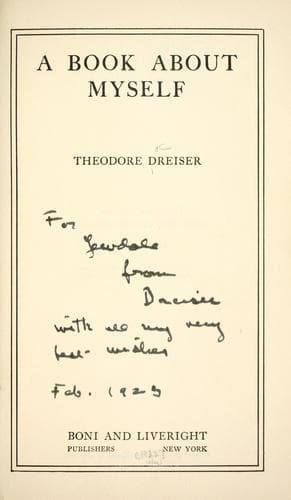
Dreiser, Theodore, 1871-1945; Journalists -- United States -- Biography; Novelists, American -- 20th century -- Biography
I indicated my willingness to undertake this and he looked at me in a
mock serious and yet approving way. He took me on and I went about the
city on one car-line and another, studying the strange streets,
expecting and fearing every moment that a brick might be shied at me
through the window or that a gang of irate workingmen would board the
car and beat me up. But nothing happened, not a single threatening
workman anywhere; I so reported and was told to write it up and make as
much of the “story” as possible. Without knowing anything of the merits
of the case, my sympathies were all with the workingmen. I had seen
enough of strikes, and of poverty, and of the quarrels between the
money-lords and the poor, to be all on one side. As was the custom in
all newspaper offices with which I ever had anything to do, where labor
and capital were concerned I was told to be neutral and not antagonize
either side. I wrote my “story” and it was published in the first
edition. Then, at the order of this same youth, I visited some charity
bazaar, where all the important paintings owned in the city were being
exhibited, and wrote an account which was headed, “As in Old Toledo,”
with all the silly chaff about “gallants and ladies gay,” after which I
spread my feet under a desk, being interested to talk more with the
smiling if indifferent youth who had employed me.
The opportunity soon came, for apparently he was as much interested in
me as I in him. He came over after I had submitted my second bit of copy
and announced that it was entirely satisfactory. A man from the
composing-room entered and commented on the fact that James Whitcomb
Riley and Eugene Field were billed to lecture in the city soon. I
remarked that I had once seen Field in the office of the News in
Chicago, which brought out the fact that my city editor had once worked
in Chicago, had been a member of the Whitechapel Club, knew Field,
Finley Peter Dunne, Brand Whitlock, Ben King and others. At mention of
the magic name of Ben King, author of “If I Should Die Tonight” and
“Jane Jones,” the atmosphere of Chicago of the time of the Whitechapel
Club and Eugene Field and Ben King returned. At once we fell into a
varied and gay exchange of intimacies.
Public-domain text, read in full here on John Shaqi.
Reviews
Reviews
No reviews yet
Be the first to share your thoughts on this work.
Elsewhere in the archive
Join the Discussion
Join the discussion
Sign in to leave a comment or review.
Sign InorCreate an account