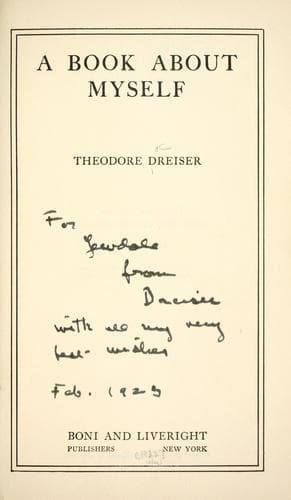
Dreiser, Theodore, 1871-1945; Journalists -- United States -- Biography; Novelists, American -- 20th century -- Biography
The next morning I was up early, determined to see as much as I could,
to visit the offices of the afternoon papers before noon, then to look
in upon the city editors of the two or three morning papers. The latter
proved not very friendly and there appeared to be no opening anywhere.
But I determined to remain here for a few days studying the city as a
city and visiting the same editors each day or as often as they would
endure me. If nothing came of it within a week, and no telegram came
from my friend H—— in Toledo calling me back, I proposed to move on; to
which city I had not as yet made up my mind.
The thing that interested me most about Cleveland then was that it was
so raw, dark, dirty, smoky, and yet possessed of one thing: force,
raucous, clattering, semi-intelligent force. America was then so new
industrially, in the furnace stage of its existence. Everything was in
the making: fortunes, art, social and commercial life. The most
impressive things were its rich men, their homes, factories, clubs,
office buildings and institutions of commerce and pleasure generally;
and this was as true of Cleveland as of any other city in America.
Indeed the thing which held my attention, after I had been in Cleveland
a day or two and had established myself in a somber room in a somber
neighborhood once occupied by the very rich, were those great and new
residences in Euclid Avenue, with wide lawns and iron or stone statues
of stags and dogs and deer, which were occupied by such rich men as John
D. Rockefeller, Tom Johnson, and Henry M. Flagler. Rockefeller only a
year or two before had given millions to revivify the almost defunct
University of Chicago, then a small Baptist college, and was accordingly
being hailed as one of the richest men of America. He and his satellites
and confreres were already casting a luster over Cleveland. They were
all living here in Euclid Avenue, and I was interested to look up their
homes, envying them their wealth of course and wishing that I were
famous or a member of a wealthy family, and that I might some day meet
one of the beautiful girls I thought must be here and have her fall in
love with and make me rich. Physically or artistically or materially,
there was nothing to see but business: a few large hotels, like those of
every American city, and these few great houses. Add a few theaters and
commonplace churches. All American cities and all the inhabitants were
busy with but one thing: commerce. They ate, drank and slept trade. In
my wanderings I found a huge steel works and a world of low, smoky,
pathetic little hovels about it. Although I was not as yet given to
reasoning about the profound delusion of equality under democracy, this
evidence of the little brain toiling for the big one struck me with
great force and produced a good deal of speculative thought later on.
Public-domain text, read in full here on John Shaqi.
Reviews
Reviews
No reviews yet
Be the first to share your thoughts on this work.
Elsewhere in the archive
Join the Discussion
Join the discussion
Sign in to leave a comment or review.
Sign InorCreate an account