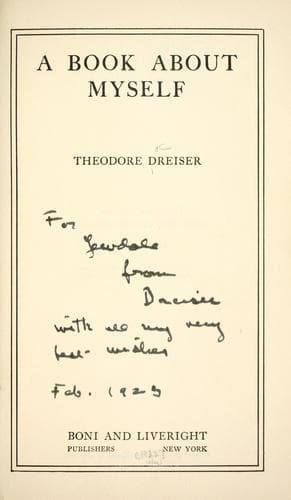
Dreiser, Theodore, 1871-1945; Journalists -- United States -- Biography; Novelists, American -- 20th century -- Biography
I descended and took a car which followed the Monongahela upstream to
Homestead, and here for the first time had a view of that enormous steel
plant which only recently (June to December, 1892) had played such a
great part in the industrial drama of America. The details of the
quarrel were fairly fresh in my mind: how the Carnegie Steel Company had
planned, with the technicalities of a wage-scale readjustment as an
excuse, to break the power of the Amalgamated Steel Workers, who were
becoming too forceful and who were best organized in their plant, and
how the Amalgamated, resenting the introduction of three hundred
Pinkerton guards to “protect” the plant, had attacked them, killing
several and injuring others, and so permitting the introduction of the
State militia, which speedily and permanently broke the power of the
strikers. They could only wait then and starve, and so they had waited
and starved for six months, when they finally returned to work, such of
them as would be received. When I reached there in April, 1894, the
battle was already fifteen months past, but the feeling was still alive.
I did not then know what it was about this town of Homestead that was so
depressing, but in the six months of my stay here I found that it was a
compound of a sense of defeat and sullen despair. The men had not
forgotten. Even then the company was busy, and had been for months,
importing Poles, Hungarians, Lithuanians, to take the places of the
ousted strikers. Whole colonies were already here, housed under the most
unsatisfactory conditions, and more were coming. Hence the despair of
those who had been defeated.
Along the river sprawled for a quarter of a mile or more the huge low
length of the furnaces, great black bottle-like affairs with rows of
stacks and long low sheds or buildings paralleling them, sheds from
which came a continuous hammering and sputtering and the glow of red
fire. The whole was shrouded by a pall of gray smoke, even in the bright
sunshine. Above the plant, on a slope which rose steeply behind it, were
a few moderately attractive dwellings grouped about two small parks, the
trees of which were languishing for want of air. Behind and to the sides
of these were the spires of several churches, those soporifics against
failure and despair. Turning up side streets one found, invariably,
uniform frame houses, closely built and dulled by smoke and grime, and
below, on the flats behind the mill, were cluttered alleys so unsightly
and unsanitary as to shock me into the belief that I was once more
witnessing the lowest phases of Chicago slum-life, the worst I had ever
seen. The streets were mere mud-tracks. Where there were trees (and
there were few) they were dwarfed and their foliage withered by a
metallic fume which was over all. Though the sun was bright at the top
of the hill, down here it was gray, almost cloudy, at best a filtered
dull gold haze.
Public-domain text, read in full here on John Shaqi.
Reviews
Reviews
No reviews yet
Be the first to share your thoughts on this work.
Elsewhere in the archive
Join the Discussion
Join the discussion
Sign in to leave a comment or review.
Sign InorCreate an account