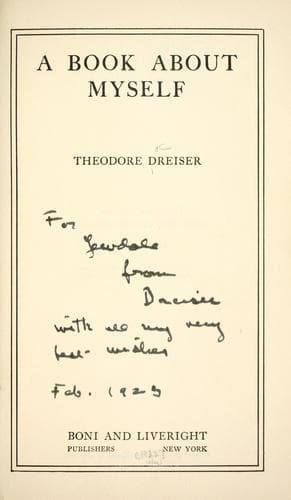
Dreiser, Theodore, 1871-1945; Journalists -- United States -- Biography; Novelists, American -- 20th century -- Biography
In Schenley Park was a huge and interesting arboretum or botanical
garden under glass, a most oriental affair given by Phipps of the
Carnegie Company. A large graceful library of white limestone, perhaps
four or five times the size of the one in Allegheny, given by Andrew
Carnegie, was in process of construction. And he was another of the
chief beneficiaries of Homestead, the possessor of a great house in this
region, another in New York and still another in Scotland, a man for
whom the unwitting “Pinkertons” and contending strikers had been killed.
Like huge ribbons of fire these and other names of powerful steel
men—the Olivers, Thaws, Fricks, Thompsons—seemed to rise and band the
sky. It seemed astonishing to me that some men could thus rise and soar
about the heavens like eagles, while others, drab sparrows all, could
only pick among the offal of the hot ways below. What were these things
called democracy and equality about which men prated? Had they any basis
in fact? There was constant palaver about the equality of opportunity
which gave such men as these their chance, but I could not help
speculating as to the lack of equality of opportunity these men created
for others once their equality at the top had made them. If equality of
opportunity had been so excellent for them why not for others,
especially those in their immediate care? True, all men had not the
brains to seize upon and make use of that which was put before them, but
again, not all men of brains had the blessing of opportunity as had
these few men. Strength, as I felt, should not be too arrogant or too
forgetful of the accident or chance by which it had arrived. It might do
something for the poor—pay them decent living wages, for instance. Were
these giants planning to subject their sons and daughters to the same
“equality of opportunity” which had confronted them at the start and
which they were so eager to recommend to the attention of others? Not at
all. In this very neighborhood I passed an exclusive private school for
girls, with great grounds and a beautiful wall—another sample of
equality of opportunity.
On the fourth day of my stay here I called again at the _Dispatch_
office and was given a position, but only after the arrival of a
telegram from Toledo offering me work at eighteen a week. Now I had long
since passed out of the eighteen-dollar stage of reporting, and this was
by no means a comforting message. If I could show it to the _Dispatch_
city editor, I reasoned, it would probably hasten his decision to accept
me, but also he might consider eighteen dollars as a rate of pay
acceptable to me and would offer no more. I decided not to use it just
then but to go first and see if anything had come about in my favor.
“Nothing yet,” he said on seeing me. “Drop around tomorrow or Saturday.
I’m sure to know then one way or the other.”
Public-domain text, read in full here on John Shaqi.
Reviews
Reviews
No reviews yet
Be the first to share your thoughts on this work.
Elsewhere in the archive
Join the Discussion
Join the discussion
Sign in to leave a comment or review.
Sign InorCreate an account