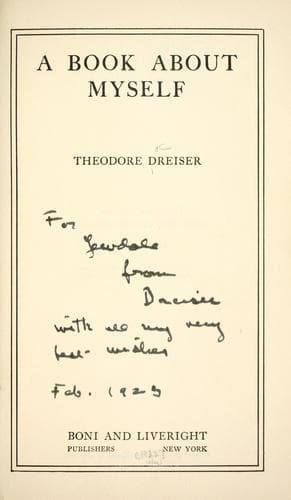
Dreiser, Theodore, 1871-1945; Journalists -- United States -- Biography; Novelists, American -- 20th century -- Biography
I opened my eyes at this news and thought dubiously of it in relation to
my own work. It did not promise much for a big feature, on which I might
spread myself.
We talked on, becoming more and more friendly. In spite of the city
editor, whom I did not like, I now began to like this place, although I
could feel that these men were more or less browbeaten, held down and
frozen. The room was much too quiet for a healthy Western reportorial
room, the atmosphere too chill.
We talked of St. Louis, its size (450,000), its principal hotels, the
Southern, the Lindell and the La Clede (I learned that its oldest and
best, the Planter, had recently been torn down and was going to be
rebuilt some day), what were the chief lines of news. It seemed that
fires, murders, defalcations, scandals were here as elsewhere the great
things, far over-shadowing most things of national and international
import. Recently a tremendous defalcation had occurred, and this new
acquaintance of mine had been working on it, had “handled it alone,” as
he said. Like all citizens of an American city he was pro-St. Louis,
anxious to say a good word for it. The finest portion of it, he told me,
was in the west end. I should see the wonderful new residences and
places. There was a great park here, Forrest, over fourteen hundred
acres in size, a wonderful thing. A new bridge was building in north St.
Louis and would soon be completed, one that would relieve traffic on the
Eads Bridge and help St. Louis to grow. There was a small city over the
river in Illinois, East St. Louis, and a great Terminal Railroad
Association which controlled all the local railroad facilities and taxed
each trunk line six dollars a car to enter and each passenger
twenty-five cents. “It’s a great graft and a damned shame, but what can
you do?” was his comment. Traffic on the Mississippi was not so much
now, owing to the railroads that paralleled it, but still it was
interesting.
The already familiar noise of a roll-top desk broke in upon us from the
next room, and I noticed a hush fall on the room. What an atmosphere! I
thought. After a few moments of silence my new friend turned to me and
whispered very softly:
“That’s Tobe Mitchell, the city editor, coming in. He’s a proper ——, as
you’ll find.” He smiled wisely and began scribbling again.
“He didn’t look so pleasant to me,” I replied as softly.
“I’ve quit here twice,” he whispered. “The next time I go I won’t come
back. I don’t have to stay here, and he knows it. I can get a job any
day on the _Chronicle_, and wouldn’t have to work so hard either. That’s
an evening paper. I stay here because I like a morning paper better,
that’s all. There’s more to it. Everything’s so scrappy and kicked
together on an evening paper. But he doesn’t say much to me any more,
although he doesn’t like me. You’d think we were a lot of kids, and this
place a schoolroom.” He frowned.
Public-domain text, read in full here on John Shaqi.
Reviews
Reviews
No reviews yet
Be the first to share your thoughts on this work.
Elsewhere in the archive
Join the Discussion
Join the discussion
Sign in to leave a comment or review.
Sign InorCreate an account