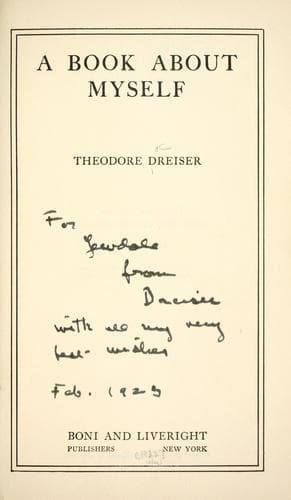
Dreiser, Theodore, 1871-1945; Journalists -- United States -- Biography; Novelists, American -- 20th century -- Biography
There is this to be said for me in regard to my not writing to her: I
was uncertain as to the financial practicability of it. In Chicago I had
been telling her of my excellent position, boasting that I was making
more than I really was. So long as I was there and not married the
pretense could easily be sustained. Here, three hundred miles away,
where she would and could not come unless I was prepared to support her,
it was a different matter. To ask her now meant a financial burden which
I did not feel able, or at least willing, to assume. No doubt I could
have starved her on twenty dollars a week; had I been desperately swayed
by love I would have done so. I could even have had her, had I so
chosen, on conditions which did not involve marriage; but I could not
bring myself to do this. I did not think it quite fair. I felt that she
would have a just claim to my continuing the relation with her.... And
outside was the wide world. I told myself that I would marry her if I
had money. If she had not been of a soft yielding type she could easily
have entrapped me, but she had not chosen to do so. Anyhow, here I was,
and here I stayed, meditating on the tragedy of it all.
By this time of course it is quite obvious that I was not an ethically
correct and moral youth, but a sentimental boy of considerable range of
feeling who, facing the confusing evidences of life, was not prepared to
accept anything as final. I did not know then whether I believed that
the morality and right conduct preached by the teachers of the world
were important or not. The religious and social aphorisms of the day had
been impressed upon me, but they did not stick. Something whispered to
me that apart from theory there was another way which the world took and
which had little in common with the strait and narrow path of the
doctrinaires. Not all men swindle in little things, or lie or cheat, but
how few fail to compromise in big ones. Perhaps I would not have
deliberately lied about anything, at least not in important matters, and
I would not now under ordinary circumstances after the one experience in
Chicago have stolen. Beyond this I could not have said how I would have
acted under given circumstances. Women were not included in my moral
speculations as among those who were to receive strict justice—not
pretty women. In that, perhaps, I was right: they did not always wish
it. I was anxious to meet with many of them, as many as I might, and I
would have conducted myself as joyously as their own consciences would
permit. That I was to be in any way punished for this, or that the world
would severely censure me for it, I did not yet believe. Other boys did
it; they were constantly talking about it. The world—the world of youth
at least—seemed to be concerned with libertinage. Why should not I be?
------------------------------------------------------------------------
CHAPTER XIX
Public-domain text, read in full here on John Shaqi.
Reviews
Reviews
No reviews yet
Be the first to share your thoughts on this work.
Elsewhere in the archive
Join the Discussion
Join the discussion
Sign in to leave a comment or review.
Sign InorCreate an account