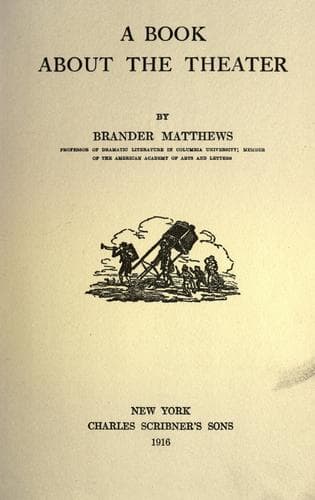
Drama -- History and criticism; Theater; Theater -- History
For the decline and fall of negro-minstrelsy it is easy to find more
than one sufficient explanation. First of all, it may have been due to
its failure to devote itself lovingly to the representation of the many
peculiarities of the negro himself. Second, it is possible that
negro-minstrelsy had an inherent and inevitable disqualification for
enduring popularity, in that it was exclusively masculine and
necessarily deprived of the potent attractiveness exerted by the members
of the more fascinating sex. And in the third place, its program was
rather limited and monotonous, and therefore negro-minstrelsy could not
long withstand the competition of the music-hall, of the variety-show,
and of the comic musical pieces, which satisfied more amply the exactly
similar taste of the public for broad fun commingled with song and
dance.
Whatever the precise cause may be, there is no denying that
negro-minstrelsy is on the verge of extinction, however much we may
bewail the fact. It failed to accomplish its true purpose, and it is
disappearing, leaving behind it little that is worthy of preservation
except a few of its songs. This, at least, it has to its credit--that it
gave Stephen Collins Foster the chance to produce his simple melodies.
Perhaps we might even venture to assert that the existence of
negro-minstrelsy is justified by a single one of these songs--by 'Old
Folks at Home,' which has a wailing melancholy and an unaffected pathos,
lacking in the earlier and more saccharine 'Home, Sweet Home,' which
the English composer, Bishop, based on an old Sicilian tune. After
Foster came Root and Work, and 'My Old Kentucky Home' was succeeded by
'Tramp, Tramp, Tramp, the Boys Are Marching,' and by 'Marching thru
Georgia'--which last lyric now shares its popularity only with 'Dixie'
as a musical relic of the Civil War.
It would be pleasant to know whether it was one of Foster's songs, and
which one it may have been that once touched the tender heart of
Thackeray. "I heard a humorous balladist not long since," the novelist
recorded, "a minstrel with wool on his head, and an ultra Ethiopian
complexion, who performed a negro ballad that I confess moistened these
spectacles in a most unexpected manner. They have gazed at dozens of
tragedy-queens dying on the stage and expiring in appropriate blank
verse, and I never wanted to wipe them. They have looked up, with deep
respect be it said, at many scores of clergymen without being dimmed,
and behold! a vagabond with a corked face and a banjo, sings a little
song, strikes a wild note, which sets the heart thrilling with happy
pity."
(1912.)
XIV
THE UTILITY OF THE VARIETY-SHOW
I
Public-domain text, read in full here on John Shaqi.
Reviews
Reviews
No reviews yet
Be the first to share your thoughts on this work.
Elsewhere in the archive
Join the Discussion
Join the discussion
Sign in to leave a comment or review.
Sign InorCreate an account