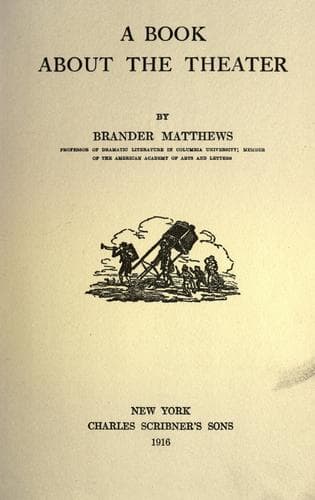
Drama -- History and criticism; Theater; Theater -- History
"Autobiography," said Longfellow--altho the remark does not seem
especially characteristic of this gentle poet--"is what biography ought
to be." And in the long list of alluring autobiographies, from Cellini's
and Cibber's, from Franklin's and Goldoni's, there are few more
fascinating than the 'Confidences of a Prestidigitator' of
Robert-Houdin. A hostile critic of Robert-Houdin's career has recorded
the fact--if it is a fact--that Robert-Houdin once confided to a fellow
magician that his autobiography had been written for him by a clever
Parisian journalist; and it must be admitted that not a few amusing
French autobiographies have not been the children of their putative
parents--for instance, the memoirs of Vidocq, the detective. Yet this is
not as damaging an admission as it may seem at first sight since the
clever Parisian journalist may have been little more than the amanuensis
of the prestidigitator, hired only to give literary form to the actual
recollections of his employer. Such a proceeding would not deprive
Robert-Houdin's autobiography by its authenticity. It remains a classic,
beloved by all who joy in the delights of conjuring. Unfortunately the
hostile critic has gone further in his attack upon Robert-Houdin's
reputation, and he has succeeded in showing that the renowned French
conjurer claimed as his own invention not a few illusions which had been
already exhibited by his predecessors in the art of deception.
Yet this unjustified boasting does not invalidate Robert-Houdin's title
to be considered the father of modern magic. Even if he was treading in
the path of those who had gone before, he attained at last to a
consistent theory of the art, far in advance of that held by earlier
magicians. Many of his marvels, and perhaps more than one of the most
striking of them, may have been but improvements upon effects originally
contrived by others; yet every succeeding generation can rise only by
standing upon the shoulders of the generations that went before, and it
is justified in availing itself of all that these earlier generations
may have discovered and invented. Robert-Houdin tells us himself that he
was greatly indebted to the Comte de Grisy, whose stage-name was
Torrini. In fact, Robert-Houdin might be called a pupil of Torrini, as
Mr. John S. Sargent is a pupil of Carolus Duran. It was upon Torrini's
dignified simplicity as a magician that Robert-Houdin modelled his own
unpretending presentation of his feats of magic. Apparently it was a
famous conjurer named Frikell, who first discarded the cumbersome and
glittering array of apparatus which used to be displayed on the stage to
dazzle the eyes of the spectators; but this discarding of obtrusive
paraphernalia was not deliberate, being due only to the accidental
destruction of Frikell's stage-furniture by fire, whereby the performer
was suddenly forced to rely upon the less complicated experiments, which
could be exhibited without extraneous aid. The abandoning of overt
Public-domain text, read in full here on John Shaqi.
Reviews
Reviews
No reviews yet
Be the first to share your thoughts on this work.
Elsewhere in the archive
Join the Discussion
Join the discussion
Sign in to leave a comment or review.
Sign InorCreate an account