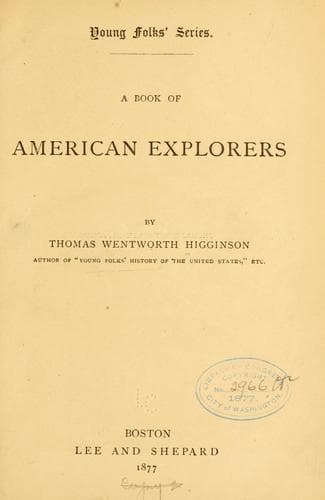
A Book of American ExplorersHigginson, Thomas Wentworth
History
A Book of American Explorers
Higginson, Thomas Wentworth
America -- Discovery and exploration; United States -- History -- Colonial period, ca. 1600-1775
This savage, one of Powhatan’s council, being amongst them held
an understanding fellow, the king purposely sent him to number
the people here, and inform him well what we were, and our state.
Arriving at Plymouth, according to his directions, he got a long
stick, whereon by notches he did think to have kept the number
of all the men he could see; but he was quickly weary of that
task. Coming to London, where by chance I met him, having renewed
our acquaintance, where many were desirous to hear and see his
behavior, he told me Powhatan did bid him to find me out, to show
him our God, the king, queen, and prince I so much had told them
of. Concerning God I told him the best I could; the king I heard
he had seen; and the rest he should see when he would. He denied
ever to have seen the king, till by circumstances he was satisfied
he had. Then he replied very sadly, “You gave Powhatan a white dog,
which Powhatan fed as himself; but your king gave me nothing, and
I am better than your white dog.”
The small time I staid in London, divers courtiers and others
my acquaintances hath gone with me to see her, that generally
concluded they did think God had a great hand in her conversion;
and they have seen many English ladies worse favored, proportioned,
and behaved. And, as since I have heard, it pleased both the
king’s and queen’s Majesty honorably to esteem her, accompanied
with that honorable lady, the Lady De la Ware, and that honorable
lord, her husband, and divers other persons of good qualities,
both publicly at the masques, and otherwise, to her great
satisfaction and content; which doubtless she would have deserved,
had she lived to arrive in Virginia.
The treasurer, council, and company having well furnished Captain
Samuel Argall, the lady Pocahontas _alias_ Rebecca with her husband
and others, in the good ship called “The George,” it pleased God at
Gravesend to take this young lady to his mercy, where she made not more
sorrow for her unexpected death than joy to the beholders to hear and
see her make so religious and godly an end. Her little child, Thomas
Rolfe, therefore was left at Plymouth with Sir Lewis Stukely that
desired the keeping of it.
XII.――FIRST BUILDINGS OF THE VIRGINIA COLONISTS.
[This description was written by Smith in the last year of his
life,――1631.]
Public-domain text, read in full here on John Shaqi.
Reviews
Reviews
No reviews yet
Be the first to share your thoughts on this work.
Elsewhere in the archive
Join the Discussion
Join the discussion
Sign in to leave a comment or review.
Sign InorCreate an account