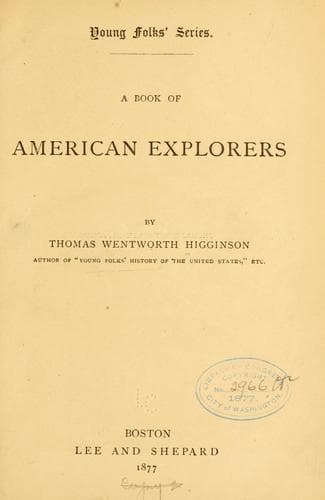
A Book of American ExplorersHigginson, Thomas Wentworth
History
A Book of American Explorers
Higginson, Thomas Wentworth
America -- Discovery and exploration; United States -- History -- Colonial period, ca. 1600-1775
Accordingly, they sent runners and watermen off to carry the news to
their scattered chiefs, that these might send off in every direction
for the warriors to come in. These arriving in numbers, and themselves
viewing the strange appearance, and that it was actually moving
towards them,――the entrance of the river or bay,――concluded it to
be a large canoe or house, in which the _Mannitto_ (great or supreme
Being) himself was, and that he probably was coming to visit them.
By this time the chiefs of the different tribes were assembled on
York Island, and were deliberating on the manner they should receive
their _Mannitto_ on his arrival. Every step had been taken to be well
provided with plenty of meat for a sacrifice. The women were required
to prepare the best of victuals; idols or images were examined, and put
in order; and a great dance was supposed not only to be an agreeable
entertainment for the _Mannitto_, but might, with the addition of a
sacrifice, contribute towards appeasing him, in case he was angry with
them. The conjurers were also set to work to determine what the meaning
of this phenomenon was, and what the result would be. Both to these,
and to the chiefs and wise men of the nation, men, women, and children
were looking up for advice and protection. Between hope and fear, and
in confusion, a dance commenced.
While in this situation, fresh runners arrive, declaring it a house
of various colors, and crowded with living creatures. It now appears
to be certain that it is the great _Mannitto_ bringing them some kind
of game, such as they had not before; but other runners, soon after
arriving, declare it a large house of various colors, full of people,
yet of quite a different color than they――the Indians――are of; that
they were also dressed in a different manner from them, and that one
in particular appeared altogether red, which must be the _Mannitto_
himself.
They are soon hailed from the vessel, though in a language they do not
understand; yet they shout――or yell――in their way. Many are for running
off to the woods, but are pressed by others to stay in order not to
give offence to their visitors, who could find them out, and might
destroy them. The house――or large canoe, as some will have it――stops,
and a smaller canoe comes ashore with the red man and some others in
it: some stay by this canoe to guard it. The chiefs and wise men (or
councillors) have composed a large circle, unto which the red-clothed
man with two others approach. He salutes them with friendly countenance;
and they return the salute, after their manner. They are lost in
admiration, both as to the color of the skin of these whites, as also
to their manner of dress, yet most as to the habit of him who wore
the red clothes, which shone with something they could not account
for. He must be the great _Mannitto_ (supreme Being), they think; but
why should he have a white skin?
Public-domain text, read in full here on John Shaqi.
Reviews
Reviews
No reviews yet
Be the first to share your thoughts on this work.
Elsewhere in the archive
Join the Discussion
Join the discussion
Sign in to leave a comment or review.
Sign InorCreate an account