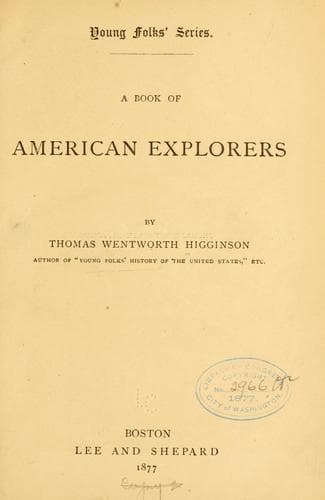
A Book of American ExplorersHigginson, Thomas Wentworth
History
A Book of American Explorers
Higginson, Thomas Wentworth
America -- Discovery and exploration; United States -- History -- Colonial period, ca. 1600-1775
After this general intoxication had ceased,――during which time the
whites had confined themselves to their vessel,――the man with the red
clothes returned again to them, and distributed presents among them;
to wit, beads, axes, hoes, stockings, &c. They say that they had become
familiar to each other, and were made to understand by signs that they
now would return home, but would visit them next year again, when they
would bring them more presents, and stay with them a while; but that,
as they could not live without eating, they should then want a little
land of them to sow seeds, in order to raise herbs to put in their
broth. That the vessel arrived the season following, and they were much
rejoiced at seeing each other; but that the whites laughed at them,
[the Indians,] seeing they knew not the use of the axes, hoes, &c.,
they had given them; they having had these hanging to their breasts as
ornaments; and the stockings they had made use of as tobacco-pouches.
The whites now put handles (or helves) in the former, and cut trees
down before their eyes, and dug the ground, and showed them the use of
their stockings. Here――say they――a general laugh ensued among them [the
Indians] that they had remained for so long a time ignorant of the use
of so valuable implements; and had borne with the weight of such heavy
metal hanging to their necks for such a length of time.
They took every white man they saw for a _Mannitto_, yet inferior and
attendant to the supreme _Mannitto_; to wit, to the one which wore the
red and laced clothes. Familiarity daily increasing between them and
the whites, the latter now proposed to stay with them, asking them only
for so much land as the hide of a bullock would cover (or encompass),
which hide was brought forward, and spread on the ground before them.
That they readily granted this request; whereupon the whites took a
knife, and, beginning at one place on this hide, cut it into a rope not
thicker than the finger of a little child, so that, by the time this
hide was cut up, there was a great heap. That this rope was drawn out
to a great distance, and then brought around again, so that both ends
might meet. That they carefully avoided its breaking, and that upon the
whole it encompassed a large piece of ground. That they [the Indians]
were surprised at the superior wit of the whites, but did not wish to
contend with them about a little land, as they had enough.
That they and the whites lived for a long time contentedly together,
although these asked from time to time more land of them; and,
proceeding higher up the _Mahicanittuk_ (Hudson River), they believed
they would soon want all their country, and which at this time was
already the case.
III.――THE LAST VOYAGE OF HENRY HUDSON, AND HOW HE WAS
SET ADRIFT IN THE ICE BY HIS MEN.
Public-domain text, read in full here on John Shaqi.
Reviews
Reviews
No reviews yet
Be the first to share your thoughts on this work.
Elsewhere in the archive
Join the Discussion
Join the discussion
Sign in to leave a comment or review.
Sign InorCreate an account