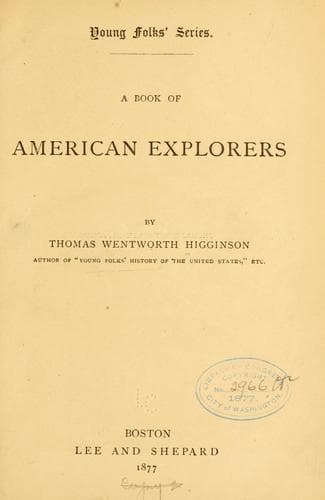
A Book of American ExplorersHigginson, Thomas Wentworth
History
A Book of American Explorers
Higginson, Thomas Wentworth
America -- Discovery and exploration; United States -- History -- Colonial period, ca. 1600-1775
There was a lusty man, and no whit less valiant, who was thought to
be their captain, stood behind a tree, within half a musket-shot of us,
and there let his arrows fly at us. He was seen to shoot three arrows,
which were all avoided; for he at whom the first arrow was aimed saw
it, and stooped down; and it flew over him. The rest were avoided also.
He stood three shots of a musket. At length one took, as he said, full
aim at him, after which he gave an extraordinary cry, and away they
went all. We followed them about a quarter of a mile: but we left six
to keep our shallop; for we were very careful of our business. Then
we shouted all together two several times, and shot off a couple of
muskets, and so returned. This we did, that they might see we were not
afraid of them, nor discouraged.
Thus it pleased God to vanquish our enemies, and give us deliverance.
By their noise we could not guess they were less than thirty or forty,
though some thought that they were many more; yet, in the dark of the
morning, we could not so well discern them among the trees as they
could see us by our fireside. We took up eighteen of their arrows,
which we have sent to England by Master Jones, some whereof were headed
with brass, others with harts’ horn, and others with eagles’ claws.
Many more, no doubt, were shot, for these we found were almost covered
with leaves: yet, by the especial providence of God, none of them
either hit or hurt us, though many came close by us, and on every side
of us; and some coats which hung up in our barricado were shot through
and through. So, after we had given God thanks for our deliverance,
we took our shallop, and went our journey, and called this place “The
First Encounter.”
IV.――THE LANDING ON PLYMOUTH ROCK.
The same exploring-party, in a shallop, finally reached Plymouth
harbor.
HAVING the wind good, we sailed all that day along the coast about
fifteen leagues, but saw neither river nor creek to put into. After
we had sailed an hour or two, it began to snow and rain, and to be
bad weather. About the midst of the afternoon, the wind increased, and
the seas began to be very rough; and the hinges of the rudder broke,
so that we could steer no longer; but two men, with much ado, were fain
to serve with a couple of oars. The seas were grown so great, that we
were much troubled and in great danger; and night drew on. Anon Master
Coppin bade us be of good cheer: he saw the harbor. As we drew near,
the gale being stiff, and we bearing great sail to get in, split our
mast in three pieces, and were like to have cast away our shallop. Yet
by God’s mercy, recovering ourselves, we had the flood[420] with us,
and struck into the harbor.
Public-domain text, read in full here on John Shaqi.
Reviews
Reviews
No reviews yet
Be the first to share your thoughts on this work.
Elsewhere in the archive
Join the Discussion
Join the discussion
Sign in to leave a comment or review.
Sign InorCreate an account