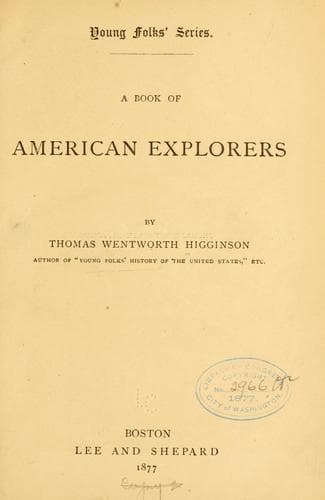
A Book of American ExplorersHigginson, Thomas Wentworth
History
A Book of American Explorers
Higginson, Thomas Wentworth
America -- Discovery and exploration; United States -- History -- Colonial period, ca. 1600-1775
87 – The side of the vessel.
88 – The Bay of Horses, probably Choctawhatchee Bay,
communicating with Pensacola Bay by Santa Rosa Inlet; but
some suppose it to have been Appalachicola Bay.
89 – St. Michael’s Day, Sept. 29.
90 – It is thought that this river may have been the Mississippi.
91 – i.e., that it would be as much as he could do.
92 – This strange incident of the revival of the men who seemed
to have died may possibly have suggested to the poet
Coleridge that passage in his “Ancient Mariner” where the
dead sailors rise up again:――
“They groaned, they stirred, they all uprose,
Nor spake, nor moved their eyes:
It had been strange, even in a dream,
To see those dead men rise.”
93 – i.e., of being offered as a sacrifice.
94 – The sea-snails and conches (or conchs) were shells of
various species.
95 – From 1528 to 1533.
96 – A small matchlock gun.
97 – Description.
98 – In the map of Ortelius, published in 1572, the name of
New France is applied to the whole of both North and South
America. “The application of this name dates back to a
period immediately after the voyage of Verrazzano; and the
Dutch voyagers are especially free in their use of it, out
of spite to the Spaniards.”――PARKMAN.
99 – July.
100 – Boiled.
101 – Regular.
102 – _Chaleur_, signifying heat in French.
103 – July, 1534.
104 – Gaspé Bay.
105 – The arms of France.
106 – Motto.
107 – Attention.
108 – The object of the cross was to take possession of the
country for the King of France; but Cartier did not
hesitate to deceive the natives by saying that it was only
for a beacon.
109 – The St. Croix River, now called St. Charles. The first
name was given because Cartier reached it on the festival
of the Holy Cross.
110 – Now Quebec.
111 – September.
112 – These were the two young Indians whom Cartier had carried
off with him the year before.
113 – This village was where Montreal now stands.
114 – A small vessel.
115 – An ingenious trick.
116 – Explanation.
117 – On land, as we say, “ashore.”
118 – Montreal.
119 – Ramparts or palisades: they were made of trunks of trees,
the outer and inner row inclining toward each other till
they met, and the third row standing upright between, to
support them.
120 – Crucifixion.
121 – Fine clothes.
122 – Please.
123 – Probably near the Hillsborough River in Florida.
124 – Men who carried swords and targets. Others carried
matchlock guns (arquebuses) or cross-bows.
125 – Crossing.
126 – Made smooth.
127 – With the same joy.
128 – Of a good family.
129 – Split.
130 – Information.
131 – The wolf.
132 – Knowing.
133 – Surround.
134 – Treat.
135 – Chief.
Public-domain text, read in full here on John Shaqi.
Reviews
Reviews
No reviews yet
Be the first to share your thoughts on this work.
Elsewhere in the archive
Join the Discussion
Join the discussion
Sign in to leave a comment or review.
Sign InorCreate an account