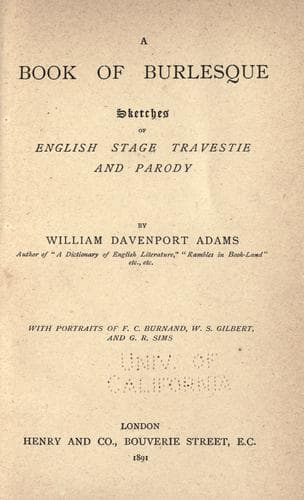
A Book of Burlesque: Sketches of English Stage Travestie and ParodyAdams, William Davenport
History
A Book of Burlesque: Sketches of English Stage Travestie and Parody
Adams, William Davenport
Burlesque (Literature); English literature -- History and criticism; Parody
"Linda di Chamouni" exercised the wit both of Mr. Conway Edwardes and
of Mr. Alfred Thompson. The former writer's "Linda di Chamouni, or the
Blighted Flower," was played at Bath in 1869; the latter's work was
presented, later in the same year, at the Gaiety. In Mr. Edwardes'
book one is most struck by the multiplicity and occasional felicity of
the "word-plays." Here, for instance, is what Pierotto says when he is
asked to take a cup of wine:--
Well, if you ask me _what_ I'll take, I think
Tea I prefer 'bove every other drink.
For when I'm teazed, vex'd, worried beyond measure,
A _cup_ of tea's to me a _source o'_ pleasure.
Whene'er I play, the game is _tea_-to-tum;
My fav'rite instrument's a "kettledrum."
I've faith, when suff'ring ills heir to humanity,
_In senna tea_ that you may say's _insanitee_.
And also p'rhaps a little odd 'twill seem here,
That I prefer the scenery of _Bohea_-mia.
And if I were engaged in deadly strife,
I'd stab my en'my with a _Bohea_ knife.
Two of Donizetti's operas--"L'Elisir d'Amore" and "La Fille du
Régiment"--were travestied by Mr. W. S. Gilbert; the former under the
title of "Doctor Dulcamara, or the Little Duck and the Great Quack,"
the latter under that of "La Vivandière, or True to the Corps." "Doctor
Dulcamara" was played at the St. James's, with Frank Matthews in the
title-part. "La Vivandière" (1868) was written for the Queen's Theatre,
where it employed the talents of Miss Henrietta Hodson, Mr. Toole, Mr.
Lionel Brough, Miss Everard (the original Little Buttercup), and Miss
Fanny Addison.
Of Verdi's operas two have been singled out for special attention--"Il
Trovatore" and "Ernani." The first of these suggested H. J. Byron's
"Ill-Treated Trovatore," seen at the Adelphi in 1863, and another
version by the same hand, played at the Olympic seventeen years after.
Byron also wrote a travestie of "Ernani," which he called "Handsome
Hernani" (Gaiety, 1879); but in this he had been anticipated by William
Brough, whose work was seen at the Alexandra Theatre in 1865.
Three travesties have been founded on the "La Sonnambula" of Bellini.
The first, which was played at the Victoria Theatre in 1835, was
from the pen of Gilbert Abbott a'Beckett, and entitled "The Roof
Scrambler"--a title explained in lines spoken by Rudolpho and
Swelvino:--
_Rud._ I tell you, there are beings in their dreams
Who scramble 'pon the house-tops.
_Swel._ So it seems.
_Rud._ Roof-scramblers they are called; for on the roofs
They walk at night--Molly is one.
Molly is the name here given to Amina; Swelvino, of course, is Elvino.
He is a sexton, and has plighted his troth to Lizzy; but before the
piece opens, he has transferred his affections to Molly Brown, a
charity girl--"a Greasy Roamer over the tops of houses." Swelvino
and Molly are about to be married, when there arrives at the village
Rodolpho, the new Inspector of Police, who introduces himself as
follows:--
Public-domain text, read in full here on John Shaqi.
Reviews
Reviews
No reviews yet
Be the first to share your thoughts on this work.
Elsewhere in the archive
Join the Discussion
Join the discussion
Sign in to leave a comment or review.
Sign InorCreate an account