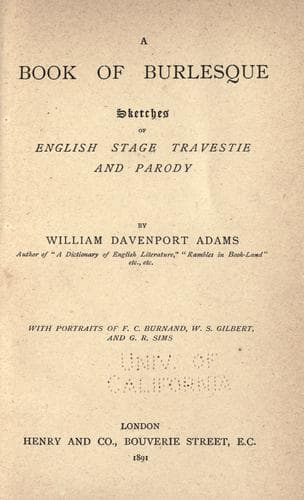
A Book of Burlesque: Sketches of English Stage Travestie and ParodyAdams, William Davenport
History
A Book of Burlesque: Sketches of English Stage Travestie and Parody
Adams, William Davenport
Burlesque (Literature); English literature -- History and criticism; Parody
But the most popular, by a long way, of all French operas, for purposes
of burlesque, has been the "Faust" of Gounod. Of the many travesties
of this, or of the story embodied in it, the earliest was that of
Halford, brought out at the Olympic in 1854. This was followed in
1857 by a piece called "Alonzo the Brave," written by Mr. Burnand for
performance by University amateurs at Cambridge, and mingling the story
of Alonzo, as told in the ballad, with that of Faust, in a fashion
effective, if a little puzzling. In this piece of extravagance (in
which, by the way, Mr. Burnand played Mephistopheles), Imogene is the
heroine, taking the place of Marguerite in the affections of Faust.
For a while, in the absence of Alonzo, she yields to the snares of the
tempter; but, in the end, her first sweetheart appears to her as his
own ghost, her inconstancy is forgiven, and Faust retires from the
scene.
Seven years later Mr. Burnand wrote a burlesque called "Faust and
Marguerite" for the St. James's. He had Ashley for his Faust, Charles
Mathews and Mrs. Charles Mathews for his Mephistopheles and Marguerite,
H. J. Montague for his Valentine, and "Johnny" Clarke for his Martha.
In this instance he followed the story of the opera pretty closely till
near the end, when Faust was sued for breach of promise of marriage,
and escaped the clutches of Mephistopheles only by consenting to pair
off with Martha! A visit to a music-hall formed part of the action, and
gave occasion for some pointed lines. Said Faust:--
I'm saddened by your modern comic singing;
and Mephistopheles went on to describe the scene:--
There sat the draper's clerk, who wildly loves
The tenth-rate _prima donna_ in cleaned gloves;
The would-be swell, who thinks it mighty grand
To shake the comic singer by the hand;
Who pays for his amusement through the nose,
And stands not on the order of his "goes."
He thinks the dark girls dressed in blue first-raters,
And is familiar with the seedy waiters;
He sips his sling or takes some sort of toddy,
And encores everything and everybody.
Marguerite says at one point--
That _circled orb_, you think, 's the moon; it ain't:
We know 'tis but a _circle daub_ of paint.
And she remarks elsewhere that
The minnow is the _minnow_-mum of fishes.
Faust says, in one place--
Our _prima donna_, sir, has gone, I guess,
To make herself _primmer_ and to _don her_ dress.
There is a diverting parody on "My Mother":--
Who guided you o'er lake and fell,
Who told you all there was to tell,
Ne'er missed a place, but showed it well?
Your Murray!
Public-domain text, read in full here on John Shaqi.
Reviews
Reviews
No reviews yet
Be the first to share your thoughts on this work.
Elsewhere in the archive
Join the Discussion
Join the discussion
Sign in to leave a comment or review.
Sign InorCreate an account