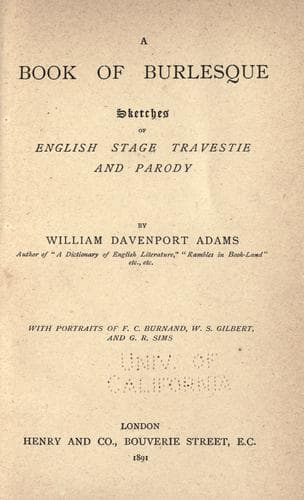
A Book of Burlesque: Sketches of English Stage Travestie and ParodyAdams, William Davenport
History
A Book of Burlesque: Sketches of English Stage Travestie and Parody
Adams, William Davenport
Burlesque (Literature); English literature -- History and criticism; Parody
English serious opera has not often fallen a prey to the untender
mercies of the parodist. Balfe and Vincent Wallace alone have been
victimised in that way--Balfe through his "Bohemian Girl" and "Rose
of Castile"; Wallace through his "Maritana." The "Bohemian Girl" has
taken four different shapes on the burlesque boards. In 1851, as
transmogrified by the Brothers Brough, she figured at the Haymarket as
"Arline." In 1864, under the auspices of Messrs. Best and Bellingham,
she appeared at Sadler's Wells under the same designation. At the
command of Mr. W. S. Gilbert she posed at the Royalty in 1868 as "The
Merry Zingara." In 1877, as portrayed by H. J. Byron at the Opéra
Comique and Gaiety, she appeared as "The Bohemian Gy-url." For his
Arline Mr. Gilbert had Miss "Patty" Oliver; for his Gipsy Queen,
Miss Charlotte Saunders; for his Count Arnheim, Fred Dewar; and for
his Devilshoof, Danvers. Byron's piece was interpreted by the Gaiety
Company. "The Rose of Castile," as treated by Mr. Conway Edwardes,
was seen in 1872 at the Brighton Theatre as "The Rows of Castile."
"Maritana," of course, was the origin and basis of Mr. Burnand's
"Mary Turner" (Holborn Theatre, 1867), as well as of Byron's "Little
Don Cæsar de Bazan" (Gaiety, 1876), in which Mr. Terry was such an
entertaining King Charles.
IX.
BURLESQUE OF FICTION AND SONG.
The writers of stage travestie have gone less to fiction for
subject-matter than might have been expected. Half a dozen romances
previous to Scott, half a dozen of Scott's own stories, about the same
number of modern novels, and still fewer foreign masterpieces--these
represent the sources of all the most important of the burlesques which
have been based upon invented prose narrative.
The earliest of the tales which have been thus dealt with is "Robinson
Crusoe." Of this time-honoured story, the first whimsical treatment
was that which took the shape of a piece called "Crusoe the Second,
or the Shipwrecked Milliners," presented at the Lyceum in 1847. This
was written by Stocqueler, and had for interpreters Mr. and Mrs.
Keeley, with Alfred Wigan (as Crusoe). It was followed, in 1860, at the
Princess's, by the "Robinson Crusoe" of H. J. Byron. Seven years later,
no fewer than six writers joined in the production of a perversion of
Defoe's tale, brought out at the Haymarket in 1867, and bearing the
names of H. J. Byron, W. S. Gilbert, T. Hood, jun., H. S. Leigh, W. J.
Prowse, and Arthur Sketchley. In this (which was given at a _matinée_
for the benefit of the family of Paul Gray, the artist) the parts
were all sustained by well-known men of art and letters. After this
there came, in 1876, at the Folly, the "Robinson Crusoe" of Mr. H. B.
Farnie,[48] which, in its turn, was followed, just ten years later,
by yet another arrangement of the story, in which Mr. Farnie had the
co-operation of Mr. Reece.
[48] With Miss Lydia Thompson as Robinson, Mr. Lionel Brough as Jim
Cocks, and Mr. Willie Edouin as Man Friday.
Public-domain text, read in full here on John Shaqi.
Reviews
Reviews
No reviews yet
Be the first to share your thoughts on this work.
Elsewhere in the archive
Join the Discussion
Join the discussion
Sign in to leave a comment or review.
Sign InorCreate an account