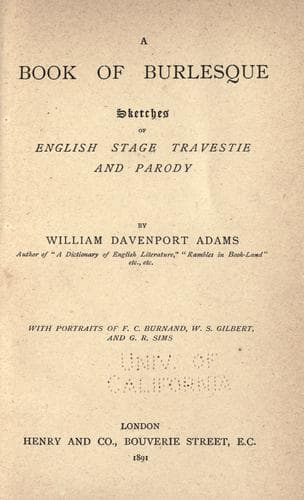
A Book of Burlesque: Sketches of English Stage Travestie and ParodyAdams, William Davenport
History
A Book of Burlesque: Sketches of English Stage Travestie and Parody
Adams, William Davenport
Burlesque (Literature); English literature -- History and criticism; Parody
Twenty-four years later, Mr. Burnand took up this subject. His work was
called "The Rise and Fall of Richard III.," and was performed at the
Royalty. His treatment of the wooing scene may well be contrasted with
that of Selby. For instance:--
_Richard._ I see that you a passion for me foster----
_Anne._ Passion for you! High, mighty, double Glo'ster.
_Rich._ Oh, call me double Glo'ster, if you please,
As long as I, in your eyes, am the cheese.
_Anne._ A cheese! Why, then I cut you. (_going_)
_Rich._ I've the daring
To ask you to consider this cheese _paring_.
_Anne._ You are hump-backed.
_Rich._ Oh, hump-bug!
_Anne._ And knock'd knee'd.
_Rich._ A friend in-knee'd, ma'am, is a friend indeed.
In puns, and good puns too, this piece is particularly prolific. Thus,
Richard's mother says of him that
He as a child took early to the bottle,
As all our family did, and my relations--
I can look back on many _ginny_-rations.
Yes, and my ancestors--they never fought
With greater spirit than at A-_gin_-court.
Buckingham says to Richard--
Don't be Protector, Richard--be Dick-tator.
Richmond says of him:--
There Richard lays;
whereupon Richard replies:--
To order sir, I rise;
Who says "_he lays_" grammatically _lies_.
Of Richmond, the Duchess of York observes:--
His hair is cut so short where once it flowed.
_Richard._ Tis a French crop, like grass--'tis _à la mowed_.
Richmond, by the way, is supposed to be fresh from France, and talks
broken English. The Duchess aforesaid asks him:--
How are you, Richmond? well? or _Richmond 'ill_?
Buckingham says to Anne:--
I'll introduce, allow me, to your Grace,
The Lord Mayor, the Recorder, and Jem _Mace_.
_Anne._ Their robes are beautiful. Oh, nicey, nicey!
Especially the _Mace_--he does look _spicey_!
But perhaps the best pun in the piece is that which is made apropos of
the fact that Catesby and Tyrell have fallen over the coal-scuttle on
the stairs and hurt themselves:--
_Richard._ My friends are hurt, so you'll excuse them grinning.
_Elizabeth._ Excuse! oh, they're more shinned against than shinning!
Talfourd's "Macbeth, somewhat removed from the Text of Shakespeare,"
was first performed in 1847 at Henley-on-Thames during the regatta;
next, at the Strand, in 1848; afterwards at the Olympic, in 1853. At
the last-named theatre it had the advantage of the aid of Robson in
the title-part, of G. Cooke as Duncan, and of Mrs. A. Phillips as Lady
Macbeth. It paraphrases the original fairly well until near the close,
when, after Macduff has slain Macbeth, Duncan reappears (like Henry VI.
in Selby's piece) and takes the crown from Malcolm. Similarly, Macbeth,
his wife, and Banquo turn up again, and announce their willingness to
die nightly.
Public-domain text, read in full here on John Shaqi.
Reviews
Reviews
No reviews yet
Be the first to share your thoughts on this work.
Elsewhere in the archive
Join the Discussion
Join the discussion
Sign in to leave a comment or review.
Sign InorCreate an account