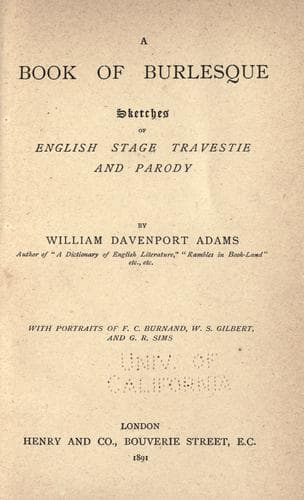
A Book of Burlesque: Sketches of English Stage Travestie and ParodyAdams, William Davenport
History
A Book of Burlesque: Sketches of English Stage Travestie and Parody
Adams, William Davenport
Burlesque (Literature); English literature -- History and criticism; Parody
Now comes the turn of the poetic drama, as represented in and by the
works of Lord Byron, Sergeant Talfourd, the first Lord Lytton, and Mr.
W. S. Gilbert. The first of Lord Byron's plays to be burlesqued was
"Manfred," which fell to the lot of Gilbert Abbott a'Beckett in 1834.
In the "burlesque ballet opera," called "Man-Fred," which thus issued
from A'Beckett's pen, Man-Fred figured as a master-sweep, very much
perturbed and disturbed by the Act in reference to chimney-sweeping
which had just been passed, and which, he plaintively declares, has
killed the trade:--
That horrible new act has marr'd his pleasure;
It really was a very _sweeping_ measure.
His lady-love, Ann Starkie, is equally unfortunate in her
business--that of apple-seller. As she remarks:--
"The trade is at a stand," the people whine:
If it be at a _stand_, 'tis not at mine.
In vain down Fleet Street with my wares I go;
Though Fleet they call the street, its trade is slow.
In the course of the piece Ann appears disguised as Mme. Grisi, and
some badinage is directed at the "stars" of the Italian Opera.
A'Beckett further undertook, along with Mark Lemon, a skit upon
another of the Byronic dramas--"Sardanapalus"--which they reproduced
as "Sardanapalus, or the 'Fast' King of Assyria." The Adelphi was the
theatre of operations; 1853 was the year; and while Miss Woolgar was
Sardanapalus, Paul Bedford was Arbaces, Keeley was Salymenia (mother of
the Queen), Miss Maskell was Beleses, and Miss Mary Keeley was Altada.
Arbaces is here shown as impervious to the charm of melody:--
Such music to my ears is a mere hum;
Of minims let me have the minimum.
Salymenia says to the King's favourite:--
Your conduct, madam, 's not at all correct:
If you're a Myrrha, why don't you reflect?
Of such are the quips and the quiddities with which the piece abounds.
In 1858 came, from the workshop of H. J. Byron, the first travestie of
his "noble kinsman's" play, "Mazeppa." This, produced at the Olympic,
had Robson for its hero, with other parts in the hands of Horace Wigan,
Mr. Lewis Ball, Miss Wyndham, Miss Bromley, and Mrs. W. S. Emden. Of
its punning dialogue, which throughout is in the genuine H. J. Byronic
manner, the following is a fair example. Olinska is conversing with her
father, the Castellan:--
_Oli._ You hate romance,--are one of its deriders.
(_Very romantically_) Give me a summer-house with _lots_ of spiders,
A poet-husband too, with rolling eyes,
In a fine phrenzy----
_Cas._ Poets I despise!
And in his phrenzy that you mention, daughter,
His _friends see_ often nought but gin and water.
_Oli._ In our sweet bower of bliss what could we fear?
Public-domain text, read in full here on John Shaqi.
Reviews
Reviews
No reviews yet
Be the first to share your thoughts on this work.
Elsewhere in the archive
Join the Discussion
Join the discussion
Sign in to leave a comment or review.
Sign InorCreate an account