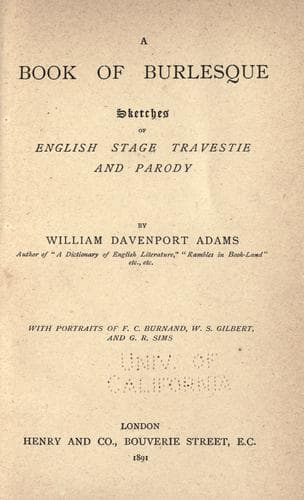
A Book of Burlesque: Sketches of English Stage Travestie and ParodyAdams, William Davenport
History
A Book of Burlesque: Sketches of English Stage Travestie and Parody
Adams, William Davenport
Burlesque (Literature); English literature -- History and criticism; Parody
"Virginius" had very much more justice done to it when Leicester
Buckingham made it the basis of a burlesque at the St. James's in
1859. Then Charles Young was the Virginius, Mrs. Frank Matthews the
Virginia, and Miss Lydia Thompson a "Mysterious Stranger," introduced,
apparently, only for the sake of a _pas seul_. In this piece the puns
are very plentiful, if not always good. Thus, Virginia says:--
Oh, deary me! each day I'm growing thinner:
Nurse says, because I never eat my dinner;
But that's not it;--in my heart there's a pain
Which makes me sigh, and sigh, and all in vain!
I've lost the plump round waist I used to prize,
And grow thin, spite of my long-_wasted_ sighs.
I love--oh! such a nice young man!--but, oh!
Does he love me?--that's what I want to know.
When we met at a party, I could see
That he was just the party to suit me;
And to the words I spoke, on his arm leaning,
Love lent a sigh to give a _si-lent_ meaning.
But he said nothing soft--that's what I cry for;
I sigh for one whose heart I can't de_ci-pher_.
Virginius, like so many other burlesque characters, delivers himself of
a reminiscence of "To be or not to be," and at the close it is found
that Virginius has not really killed his daughter, because she "pads."
"Alfred the Great," one of Knowles' historical plays, suggested
portions of the burlesque called "Alfred the Great, or the Minstrel
King," which Robert B. Brough wrote for the Olympic in 1859. In this,
Robson was the King, Miss Herbert his aide-de-camp, and F. Vining his
commander-in-chief, with other parts by Horace Wigan and Miss Hughes.
Knowles's "William Tell" (1825), or the story embodied in it has
been the basis of half a dozen travesties. First came Mr. Burnand's
"William Tell," at Drury Lane, in 1856; next, Leicester Buckingham's,
at the Strand, in 1857; next, Talfourd's "Tell! and the Strike of the
Cantons, or the Pair, the Meddler, and the Apple!" at the Strand,
in 1859-60; next, again, Byron's "William Tell with a Vengeance! or
the Pet, the Parrot, and the Pippin," at the Strand, in 1867; a few
days later, A. J. O'Neill's "William Tell," at Sadler's Wells; and,
lastly--so far--Mr. Reece's "William Tell told Over Again," at the
Gaiety, in 1876. "The Hunchback" has been "guyed" less often than might
have been expected, considering its popularity. Mr. Burnand brought out
at the Olympic, in 1879, "The Hunchback Back Again," and this comic
version of the hackneyed old play is not likely to be superseded.
Public-domain text, read in full here on John Shaqi.
Reviews
Reviews
No reviews yet
Be the first to share your thoughts on this work.
Elsewhere in the archive
Join the Discussion
Join the discussion
Sign in to leave a comment or review.
Sign InorCreate an account