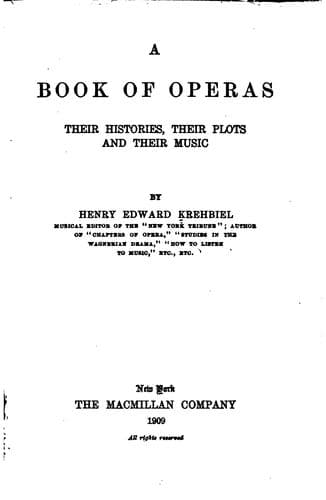
A Book of Operas: Their Histories, Their Plots, and Their MusicKrehbiel, Henry Edward
History
A Book of Operas: Their Histories, Their Plots, and Their Music
Krehbiel, Henry Edward
Operas -- Stories, plots, etc.
The plot of "La Traviata" we have already given to our readers. It
is simply "Camille." The first scene affords us some waltzing music,
appropriate in its place, on which a (musical) dialogue takes place.
The waltz is not specially good, nor is there any masterly
outworking of detail. A fair drinking song is afforded, which
pleased, but was not encored. A pretty duet by Mme. de la Grange and
Signor Brignoli may be noticed also in this act; and the final air,
by Madame de la Grange, "Ah! fors' e lui che l'anima," contained a
brilliant, florid close which brought down the house, and the
curtain had to be reraised to admit of a repetition. Act II admits
of more intensified music than Act I. A brief air by Alfred
(Brignoli) is followed by an air by Germont (Amodio), and by a duet,
Violetta (La Grange) and Germont. The duet is well worked up and is
rousing, passionate music. Verdi's mastery of dramatic accent--of
the modern school of declamation--is here evident. Some dramatic
work, the orchestra leading, follows--bringing an air by Germont,
"Di Provenza il mar." This is a 2-4 travesty of a waltz known as
Weber's Last Waltz (which, however, Weber never wrote); and is too
uniform in the length of its notes to have dramatic breadth or
eloquence. A good hit is the sudden exit of Alfred thereupon, not
stopping to make an andiamo duet as is so often done. The next scene
introduces us to a masquerade where are choruses of quasi-gypsies,
matadors, and picadors,--sufficiently characteristic. The scene
after the card-playing, which is so fine in the play, is inefficient
in music. Act III in the book (though it was made Act IV on this
occasion by subdividing the second) reveals the sick-room of
Traviata. A sweet air, minor and major by turns, with some hautboy
wailing, paints the sufferer's sorrows. A duet by the lovers,
"Parigi, O cara," is especially original in its peroration. The
closing trio has due culmination and anguish, though we would have
preferred a quiet ending to a hectic shriek and a doubly loud force
in the orchestra.
Goldsmith's rule in "The Vicar" for criticising a painting was
always to say that "the picture would have been better if the
painter had taken more pains." Perhaps the same might be said about
"La Traviata"; but whether it would have pleased the public more is
another question. Some of the airs certainly would bear substitution
by others in the author's happier vein. The opera was well received.
Three times the singers were called before the curtain. The piece
was well put on the stage. Madame La Grange never looked so well.
Her toilet was charming.
Public-domain text, read in full here on John Shaqi.
Reviews
Reviews
No reviews yet
Be the first to share your thoughts on this work.
Elsewhere in the archive
Join the Discussion
Join the discussion
Sign in to leave a comment or review.
Sign InorCreate an account