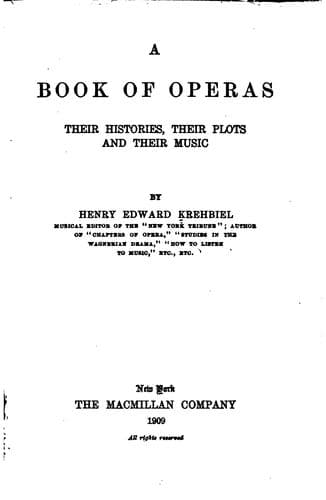
A Book of Operas: Their Histories, Their Plots, and Their MusicKrehbiel, Henry Edward
History
A Book of Operas: Their Histories, Their Plots, and Their Music
Krehbiel, Henry Edward
Operas -- Stories, plots, etc.
Two erroneous impressions concerning Verdi's "Aïda" may as well as
not be corrected at the beginning of a study of that opera: it was
not written to celebrate the completion of the Suez Canal, nor to
open the Italian Opera-house at Cairo, though the completion of
the canal and the inauguration of the theatre were practically
contemporaneous with the conception of the plan which gave the world
one of Verdi's finest and also most popular operas. It is more
difficult to recall a season in any of the great lyric theatres of
the world within the last thirty-five years in which "Aïda" was not
given than to enumerate a score of productions with particularly
fine singers and imposing mise en scène. With it Verdi ought to
have won a large measure of gratitude from singers and impresarios
as well as the fortune which it brought him; for though, like all
really fine works, it rewards effort and money bestowed upon it with
corresponding and proportionate generosity, it does not depend for
its effectiveness on extraordinary vocal outfit or scenic apparel.
Fairly well sung and acted and respectably dressed, it always wins
the sympathies and warms the enthusiasm of an audience the world
over. It is seldom thought of as a conventional opera, and yet it
is full of conventionalities which do not obtrude themselves simply
because there is so much that is individual about its music and its
pictures--particularly its pictures. Save for the features of its
score which differentiate it from the music of Verdi's other operas
and the works of his predecessors and contemporaries, "Aïda" is a
companion of all the operas for which Meyerbeer set a model when
he wrote his works for the Académie Nationale in Paris--the great
pageant operas like "Le Prophète," "Lohengrin," and Goldmark's
"Queen of Sheba." With the last it shares one element which brings
it into relationship also with a number of much younger and less
significant works--operas like Mascagni's "Iris," Puccini's "Madama
Butterfly," and Giordano's "Siberia." In the score of "Aïda" there
is a slight infusion of that local color which is lavishly employed
in decorating its externals. The pomp and pageantry of the drama are
Egyptian and ancient; the play's natural and artificial environment
is Egyptian and ancient; two bits of its music are Oriental,
possibly Egyptian, and not impossibly ancient. But in everything
else "Aïda" is an Italian opera. The story plays in ancient Egypt,
and its inventor was an archaeologist deeply versed in Egyptian
antiquities, but I have yet to hear that Mariette Bey, who wrote the
scenario of the drama, ever claimed an historical foundation for
it or pretended that anything in its story was characteristically
Egyptian. Circumstances wholly fortuitous give a strong tinge of
antiquity and nationalism to the last scene; but, if the ancient
Egyptians were more addicted than any other people to burying
malefactors alive, the fact is not of record; and the picture as we
Public-domain text, read in full here on John Shaqi.
Reviews
Reviews
No reviews yet
Be the first to share your thoughts on this work.
Elsewhere in the archive
Join the Discussion
Join the discussion
Sign in to leave a comment or review.
Sign InorCreate an account