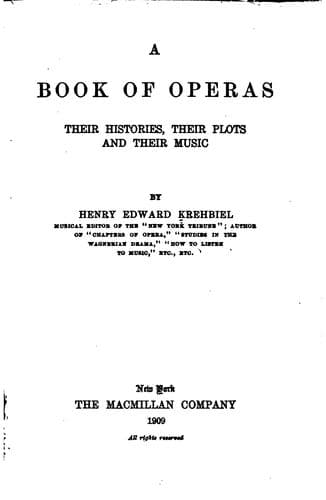
A Book of Operas: Their Histories, Their Plots, and Their MusicKrehbiel, Henry Edward
History
A Book of Operas: Their Histories, Their Plots, and Their Music
Krehbiel, Henry Edward
Operas -- Stories, plots, etc.
The story of "Aïda" came from Mariette Bey, who was then director
of the Egyptian Museum at Boulak. Auguste Édouard Mariette was a
Frenchman who, while an attaché of the Louvre, in 1850, had gone on
a scientific expedition to Egypt for the French government and had
discovered the temple of Serapis at Memphis. It was an "enormous
structure of granite and alabaster, containing within its enclosure
the sarcophagi of the bulls of Apis, from the nineteenth dynasty to
the time of the Roman supremacy." After his return to Paris, he was
appointed in 1855 assistant conservator of the Egyptian Museum in
the Louvre, and after some further years of service, he went to
Egypt again, where he received the title of Bey and an appointment
as director of the museum at Boulak. Bayard Taylor visited him in
1851 and 1874, and wrote an account of his explorations and the
marvellous collection of antiquities which he had in his care.
Mariette wrote the plot of "Aïda," which was sent to Verdi, and at
once excited his liveliest interest. Camille du Locle, who had had
a hand in making the books of "Les Vêpres Siciliennes" and "Don
Carlos" (and who is also the librettist of Reyer's "Salammbô"), went
to Verdi's home in Italy, and under the eye of the composer wrote
out the drama in French prose. It was he who gave the world the
information that the idea of the double scene in the last act was
conceived by Verdi, who, he says, "took a large share in the work."
The drama, thus completed, was translated into Italian verse by
Antonio Ghislanzoni, who, at the time, was editor of the Gazetta
Musicale, a journal published in Milan. In his early life
Ghislanzoni was a barytone singer. He was a devoted friend and
admirer of Verdi's, to whom he paid a glowing tribute in his book
entitled "Reminiscenze Artistiche." He died some fifteen or sixteen
years ago, and some of his last verses were translations of
Tennyson's poems.
Public-domain text, read in full here on John Shaqi.
Reviews
Reviews
No reviews yet
Be the first to share your thoughts on this work.
Elsewhere in the archive
Join the Discussion
Join the discussion
Sign in to leave a comment or review.
Sign InorCreate an account