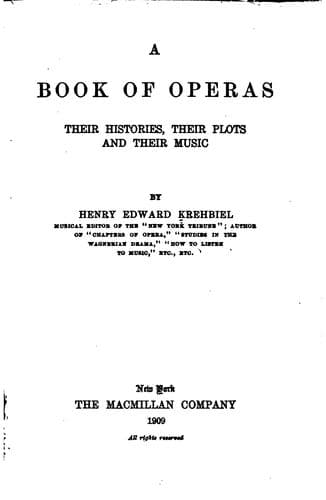
A Book of Operas: Their Histories, Their Plots, and Their MusicKrehbiel, Henry Edward
History
A Book of Operas: Their Histories, Their Plots, and Their Music
Krehbiel, Henry Edward
Operas -- Stories, plots, etc.
Act II. News of the success of the Egyptian expedition against the
Ethiopians has reached Amneris, whose slaves attire her for the
scene of Radames's triumph. The slaves sing of Egypt's victory and
of love, the princess of her longing, and Moorish slaves dance
before her to dispel her melancholy. Aïda comes, weighed down by
grief. Amneris lavishes words of sympathy upon her, and succeeds in
making her betray her love for Radames by saying that he had been
killed in battle. Then she confesses the falsehood and proclaims her
own passion and purpose to crush her rival, who shall appear at the
triumph of Radames as her slave. Aïda's pride rebels for the moment,
and she almost betrays her own exalted station as the daughter of a
king. As a slave she accompanies the princess to the entrance gate
of Thebes, where the King, the priests, and a vast concourse of
people are to welcome Radames and witness his triumphal entry.
Radames, with his troops and a horde of Ethiopian prisoners, comes
into the city in a gorgeous pageant. The procession is headed by two
groups of trumpeters, who play a march melody, the stirring effect
of which is greatly enhanced by the characteristic tone quality of
the long, straight instruments which they use:--
[Musical excerpt]
A word about these trumpets. In shape, they recall antique
instruments, and the brilliancy of their tone is due partly to the
calibre of their straight tubes and partly to the fact that nearly
all the tones used are open--that is, natural harmonics of the
fundamental tones of the tubes. There is an anachronism in the
circumstance that they are provided with valves (which were not
invented until some thousands of years after the period of the
drama), but only one of the valves is used. The first trumpets are
in the key of A-flat and the second B-natural, a peculiarly stirring
effect being produced by the sudden shifting of the key of the march
when the second group of trumpeters enters on the scene.
The King greets Radames with an embrace, bids him receive the wreath
of victory from the hands of his daughter and ask whatever boon
he will as a reward for his services. He asks, first, that the
prisoners be brought before the King. Among them Aïda recognizes
her father, who is disguised as an officer of the Ethiopian army.
The two are in each other's arms in a moment, but only long enough
for Amonasro to caution his daughter not to betray him. He bravely
confesses that he had fought for king and country, and pleads for
clemency for the prisoners. They join in the petition, as does
Aïda, and though the priests warn and protest, Radames asks the
boon of their lives and freedom, and the King grants it. Also,
without the asking, he bestows the hand of his daughter upon the
victorious general, who receives the undesired honor with
consternation.
Public-domain text, read in full here on John Shaqi.
Reviews
Reviews
No reviews yet
Be the first to share your thoughts on this work.
Elsewhere in the archive
Join the Discussion
Join the discussion
Sign in to leave a comment or review.
Sign InorCreate an account